

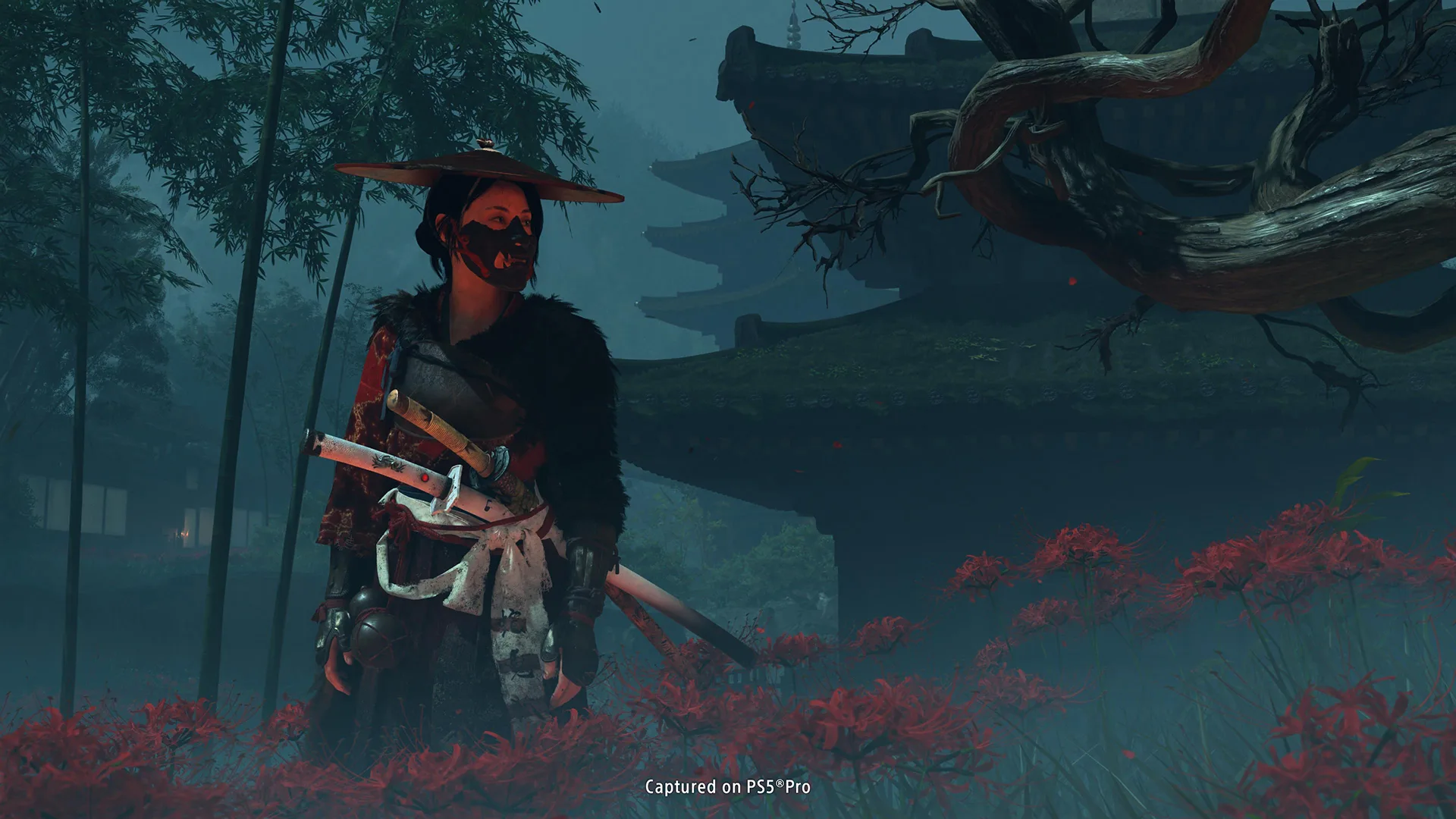
“I wouldn’t go in there,” warns traveling storyteller Ugetsu, as Atsu approaches two large and looming wooden doors. “Because you may not return.”
It’s a caution many Ghost of Yōtei players loved to ignore. As the trigger point for revered side-quest The Spider Lily General, that ominous gate is the start of a haunting mythological adventure that lingers long in memory after its completion. Only fitting for a game that launched so close to Halloween.
I spoke to Creative Directors, Nate Fox and Jason Connell, to find out the inspiration and secrets behind The Spider Lily General, and how they felt about the optional quest’s popularity. But, similar to Ugetsu, I must warn you – there are spoilers ahead. You might want to play this mission before venturing any further…
The quest’s origins
“The Spider Lily General was actually one of the earliest missions in the game and one of the first Mythic Tales we created,” reveals Jason. “It came from one of our designers and writers, and we dissected what makes a great Mythic mission, how they’d look and feel.”
View and download image
Download the image
close
Close
Verify your age to view this content.
Verify your age to view this content.
View and download image
Download the image
close
Close
While these particular side-quests can be inspired by historical figures, The Spider Lily General was crafted as an original tale to represent the trauma of war. The titular warrior’s battle prowess and armour turned him into a legend, but after retiring, the General accidently injures his daughter during a sparring session. Seeing his child die from a wound he inflicted poisons the General with unrelenting grief, leading to him haunting the forest. And now looters hunt for his armour, often dying by the ghost’s sword.
“We knew we wanted the story to maybe have some tragedy associated with it,” says Jason. “And at some point the writer suggested it could be a point of reflection for Atsu, who helps him heal. She’s fighting him, but understands his trauma.”
But why spider lilies? Was there some specific symbolism in their use, given the myth says they sprouted wherever the General spilled his victims’ blood?
“They’re actually toxic, and in real life they’re planted in graveyards to keep away animals,” explains Nate. “So they represent death, as well as connecting to emotional relationships. They also had a functional in-game purpose – early playable feedback suggested it was a bit hard to understand where to go and what to do in the mission because the area is so large. So the lilies made it clearer how to move through the mist.”
Developing horror
The practical use of the lilies were just one of many mechanical aspects Sucker Punch had to consider for a quest which took on such an eerie feel in contrast to much of the main game.
“We don’t have a lot of experience with that sort of horror tone,” says Nate. “So there were specific ways to make it feel like the world is not as you know it. The little maze, a music stinger, and hearing people wailing in the distance. Or reaching a bunch of enemies before a mist rolls in and you then find them all slaughtered.
“There’s also the use of negative space, like when you start the quest and go up a staircase with the mist coming down and the spider lilies going up, with old corpses present… but nothing is attacking you. That long walk is simply there to immerse you in the tone.”
View and download image
Download the image
close
Close
View and download image
Download the image
close
Close
View and download image
Download the image
close
Close
View and download image
Download the image
close
Close
View and download image
Download the image
close
Close
Early development concepts of the Spider Lily mission by Sucker Punch.
“We were inspired by elements from past survival horror games,” explains Jason. “The prototypes explored weird camera angles. It was really challenging, but even if we didn’t use them it set the vibe for what we were trying to achieve.
The atmosphere is one of the biggest tools we have. You paint the whole scene with mood. We made the spooky moon a little bigger and changed the lighting and colour grading to get the right black level. Sound design is a big thing, too, as well as the music, like the special track during the duel.”
View and download image
Download the image
close
Close
Verify your age to view this content.
Verify your age to view this content.
Its influence on the wider game
Similar to the impact The Spider Lily General had on players, its early inclusion to Ghost of Yōtei’s development helped set a high bar not just for the other Mythic quests, but also for the entire adventure.
“The mission paved the way to ensure that the rest of the game had that level of quality and majesty,” says Jason. “A lot of the core parts of what makes the atmosphere and visual style of a Ghost game distinct got re-pioneered in that moment – and it reminded us of how important it is to use really great visual attractions to draw the player in.”
“That’s one of my favourite things about the mission,” agrees Nate. “When you’re riding your horse in this expansive field, the player has the choice of where they want to go. But when you look at the forest, it’s got a little bit of mist on it and you see this beautiful pagoda popping up out of the top, and it really excites your curiosity. The player discovers the story under their own power. It’s a powerful experience.”
The impact of myth on players… and the studio
The work and thought gone into The Spider Lily General is reflective of the entire game, but the team is happy with how players have responded to this particular mission, especially given how invested the studio was in creating the Mythics.
“Nate and I were pretty excited about the way they came out in Ghost of Tsushima,” says Jason. “So we knew that we wanted to build them again in their own new way for Ghost of Yōtei. And it’s cool to see people really enjoy The Spider Lily General. It’s got a lot of the hallmarks of a Ghost game in its roots. So as creators it’s really joyful to see people take photos and talk about why they like that mission.”
“We set out to make a game that is an anthology of stories where the player is invited to really wander, and follow their curiosity,” says Nate. “And The Spider Lily General is a great example of the kinds of things you can discover by going out there and exploring, in its own self-contained short story.
“It has a really strong beginning, middle, and end, with characters you get to know. Everyone in the team is very proud of how it came together.”
Ghost of Yōtei is available for PS5 now.
