

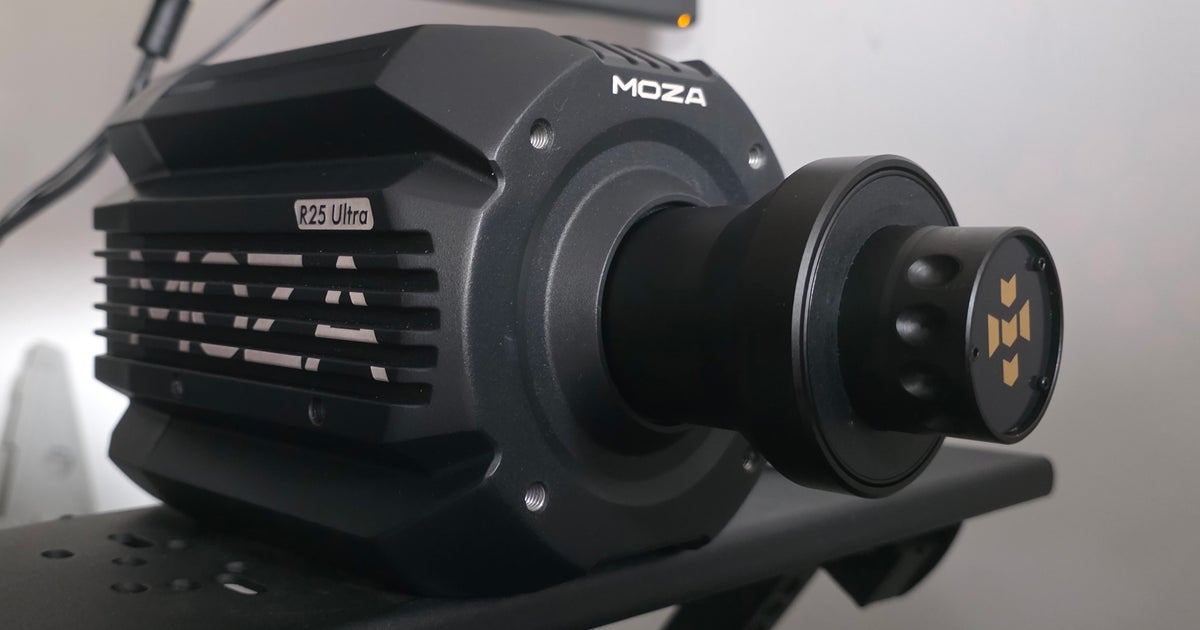
Moza is recognized for producing high-quality sim racing equipment, ranging from budget-friendly starter kits to advanced wheel bases, rims, and pedals. This review focuses on the Moza R25 Ultra, a premium offering first revealed at Gamescom.
Priced at £899/$899, the R25 Ultra stands as Moza’s most potent wheel base, delivering a consistent 25Nm of torque. This output significantly surpasses the most powerful direct drive options from competitors like Logitech and Thrustmaster. It incorporates a new 21-bit magnetic encoder and a zero-cogging flat wire motor, engineered to provide exceptionally smooth force feedback and a refined driving experience, even at lower power settings.
This review examines whether these advancements offer a significant upgrade compared to previous Moza wheel bases, such as the R9. It also assesses the R25 Ultra’s performance against similarly priced alternatives like the Logitech Pro Racing Wheel and Thrustmaster T818, exploring the practical benefits of its increased power.
Hardware Overview
The Moza R25 Ultra adopts a ridged cuboid design, departing from the broader, more streamlined form of the previous R21. This new shape aligns more closely with other Moza products and is notably more compact than many 25Nm wheel bases. During operation, the unit maintained a cool temperature, likely due to its increased surface area for heat dissipation. RGB LEDs are integrated along the sides, offering customization options such as manual settings, disabling, or displaying race telemetry like yellow flags, gear shifts, or ABS activation.
The R25 Ultra supports all three standard wheel base mounting configurations: bottom-mounted bolts, side mounts, and front mounts. Additional smaller bolt holes are present for attaching a Moza dash. While a bottom mount was utilized for testing with a Next Level Racing GTTrack cockpit, the availability of all mounting options is beneficial, especially since alternative styles are prevalent in higher-end cockpits. As expected for a premium wheel base, a desk clamp mount is not included.
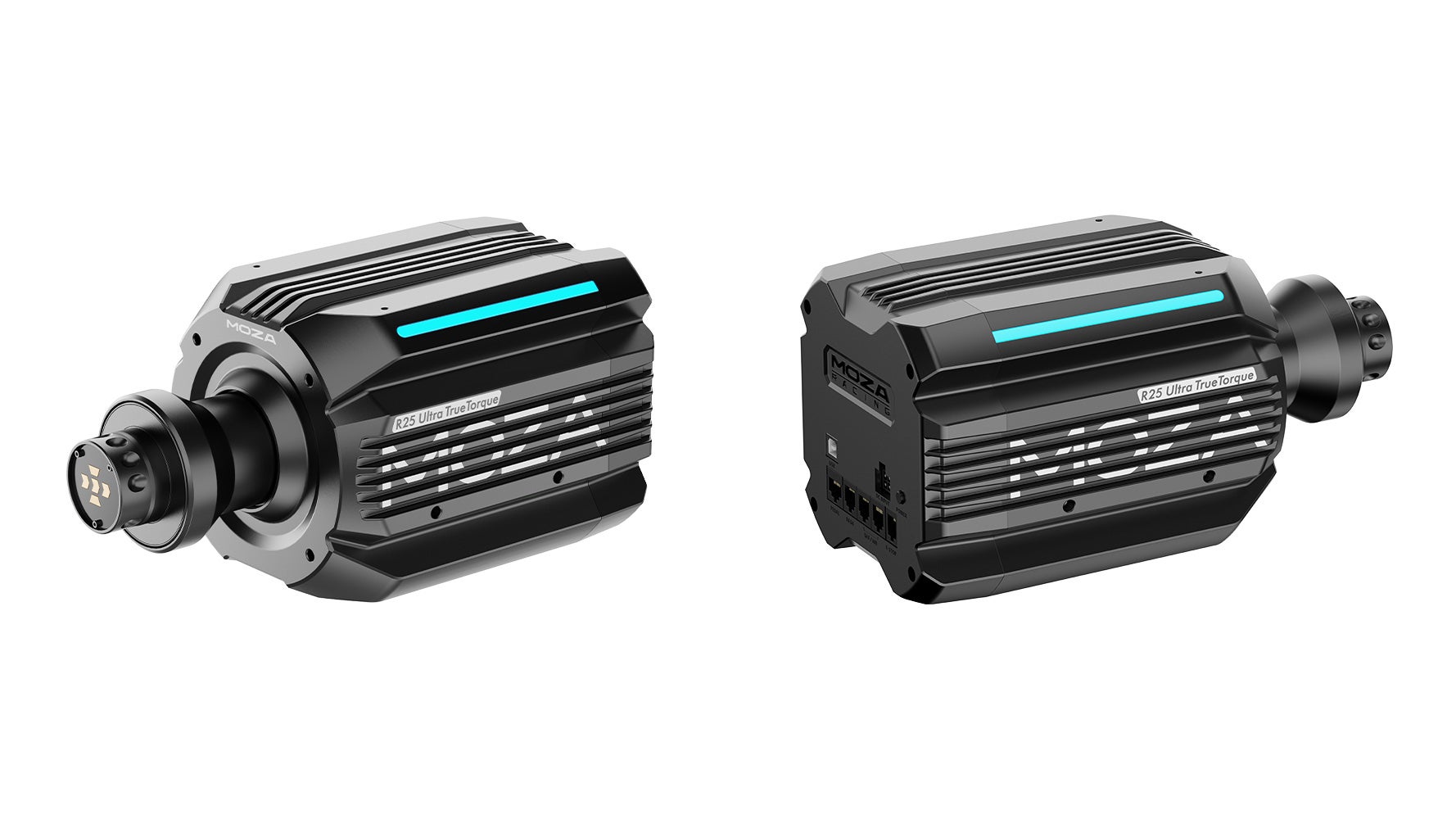
Here are the official photos – note the ‘TrueTorque’ branding not reflected on my unit, the RGB light strips, the standard Moza Quick Release pattern and the mounting holes throughout.
The unit lacks USB pass-through for third-party wheel rims, but it accommodates various Moza accessories such as pedals, shifters, and handbrakes. A USB-B port facilitates connection to a PC; this type of cable can be slightly less common than the USB-C found on some other wheel bases, like the PXN VD10. Other connections include a power input and an on/off switch. A dedicated emergency stop button is not integrated but can be wired externally.
Overall, the R25 Ultra presents a professional appearance, particularly when contrasted with the older R21. Its relatively light and low-profile design is notable, considering the substantial power it delivers.
Software Overview
Moza’s Pit House software has evolved significantly, transforming from its initial basic state into what many consider a leading sim racing package. It offers straightforward adjustments for common user preferences, including setting maximum force feedback levels, managing firmware updates, and defining steering angles. The Pit House app also allows for one-click game configurations from its main interface, with comprehensive documentation and proactive support for any necessary manual adjustments.
Users can delve into extensive force feedback settings, accessing advanced parameters such as speed-dependent damping or steering inertia. A notable addition is a graphical equalizer, enabling precise adjustments to force feedback strength across different frequencies. This feature allows users to suppress unwanted effects and amplify subtle sensations, such as tire traction loss, enhancing the personalized driving experience.
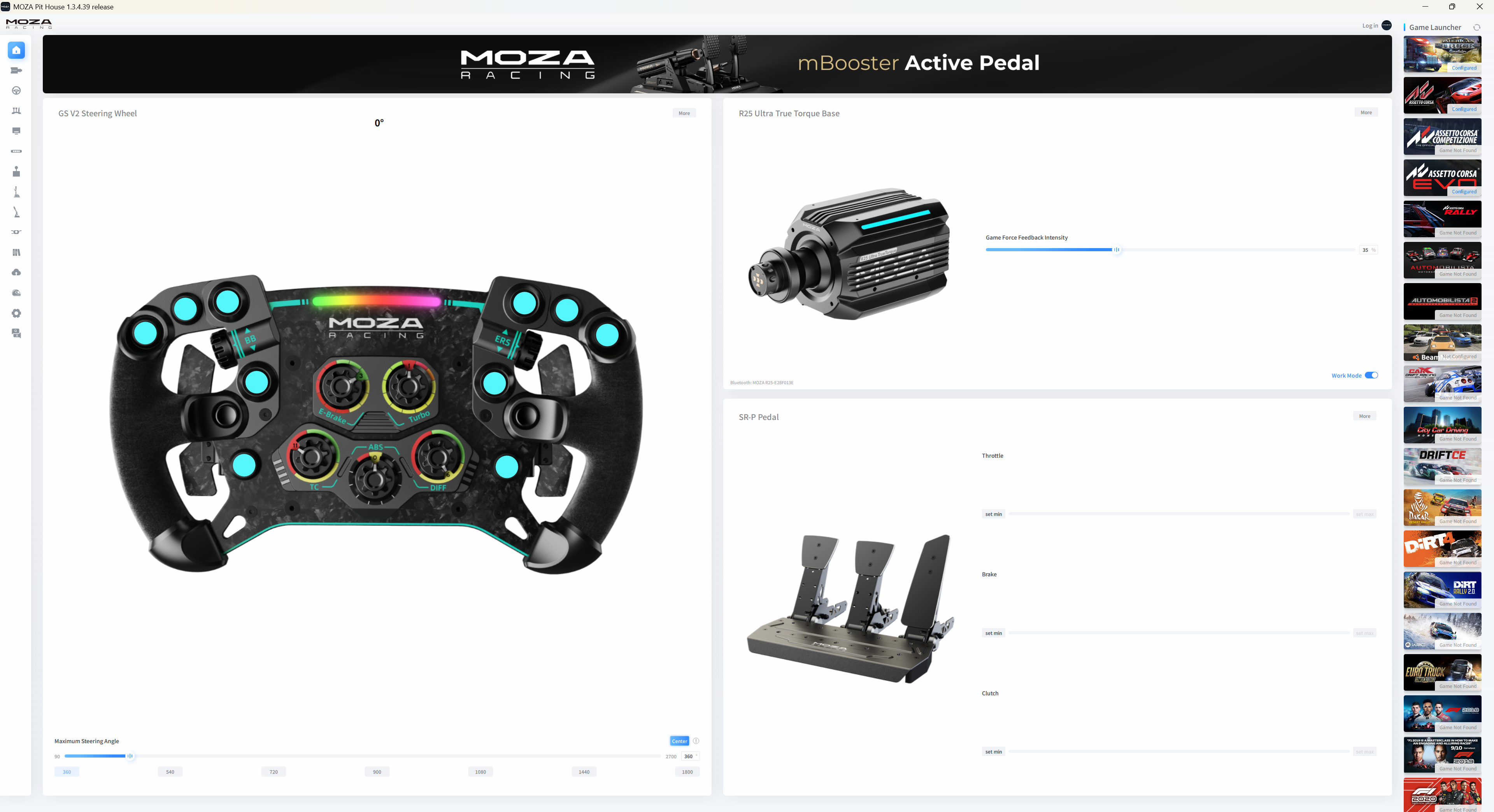
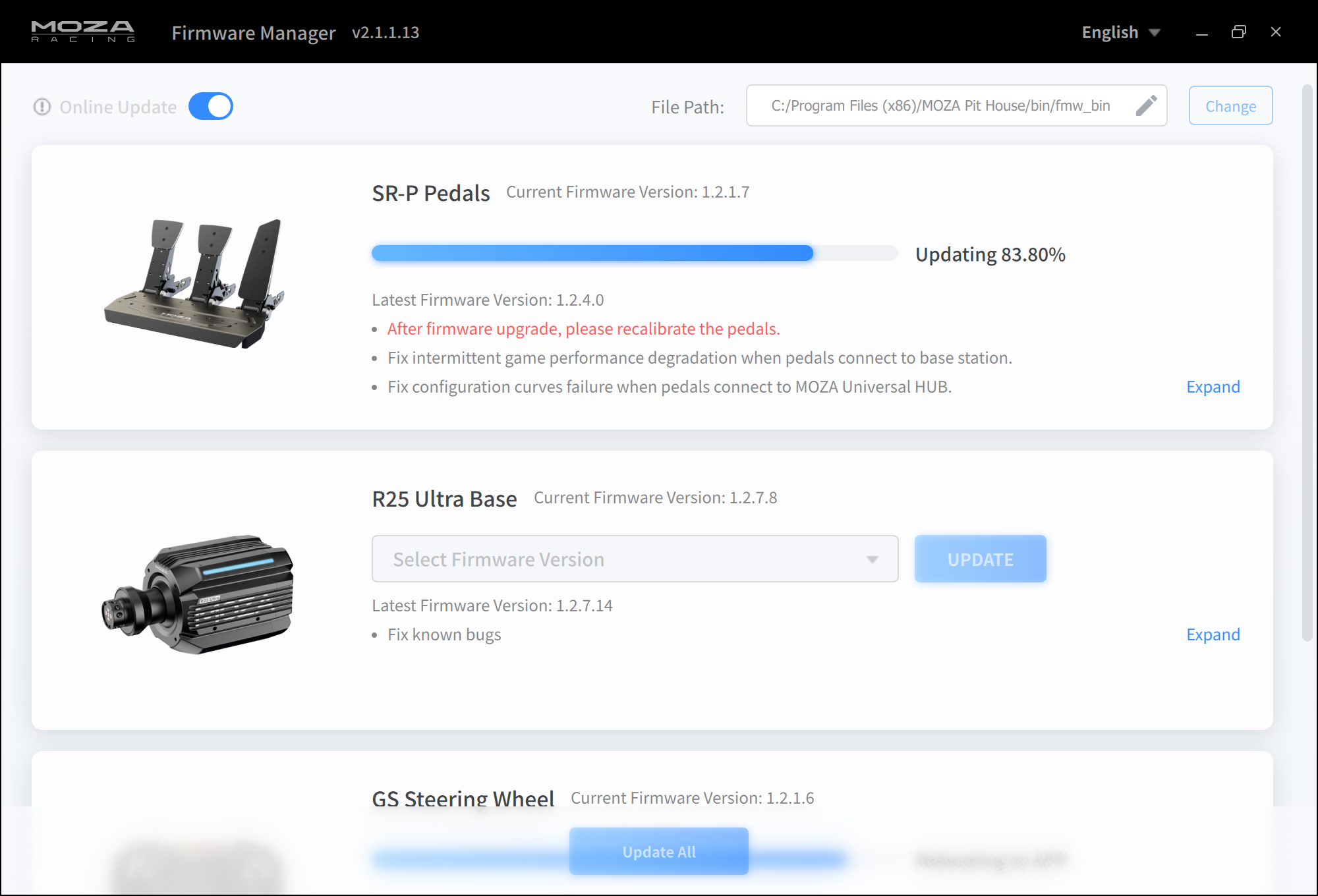
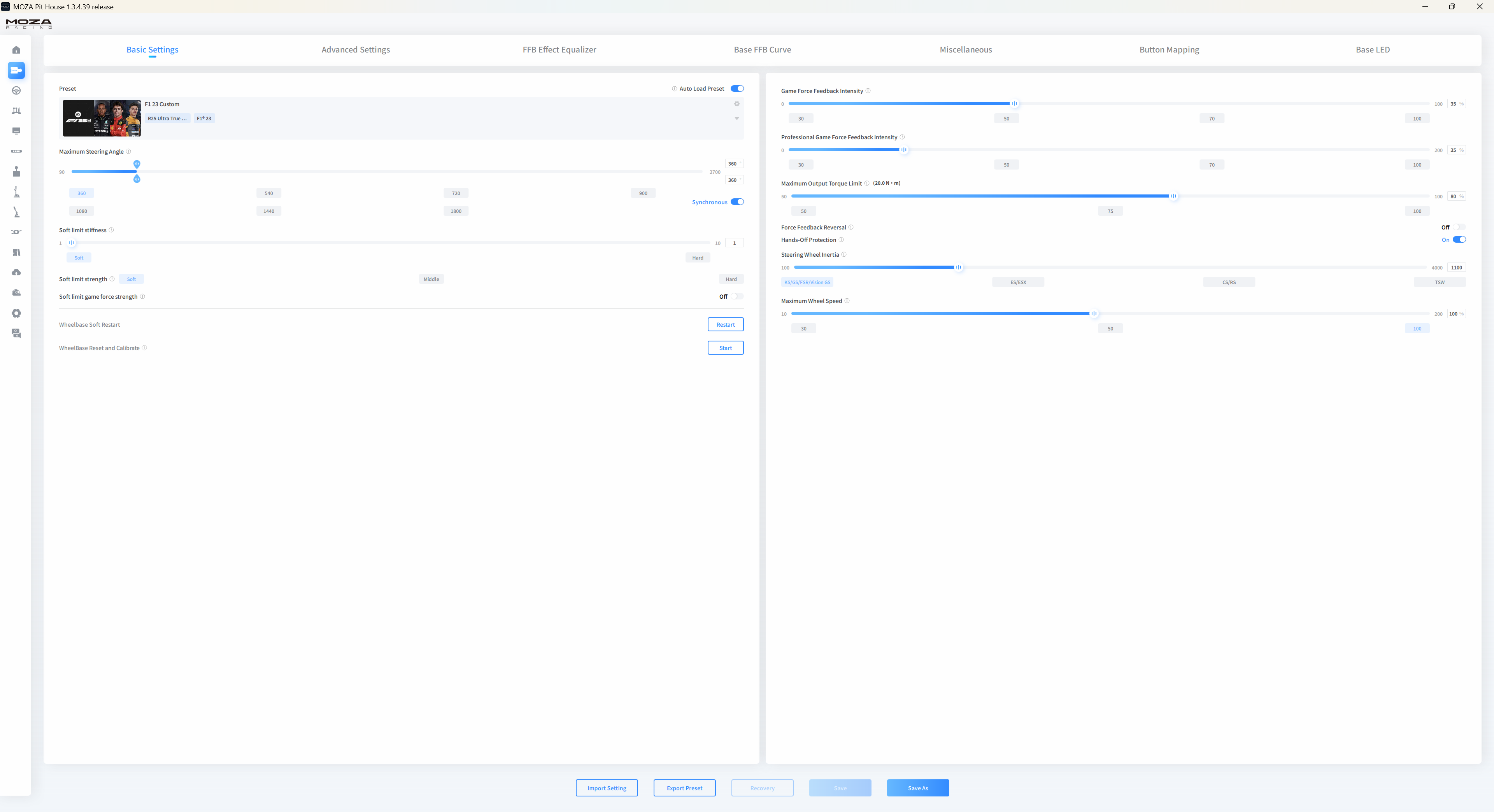
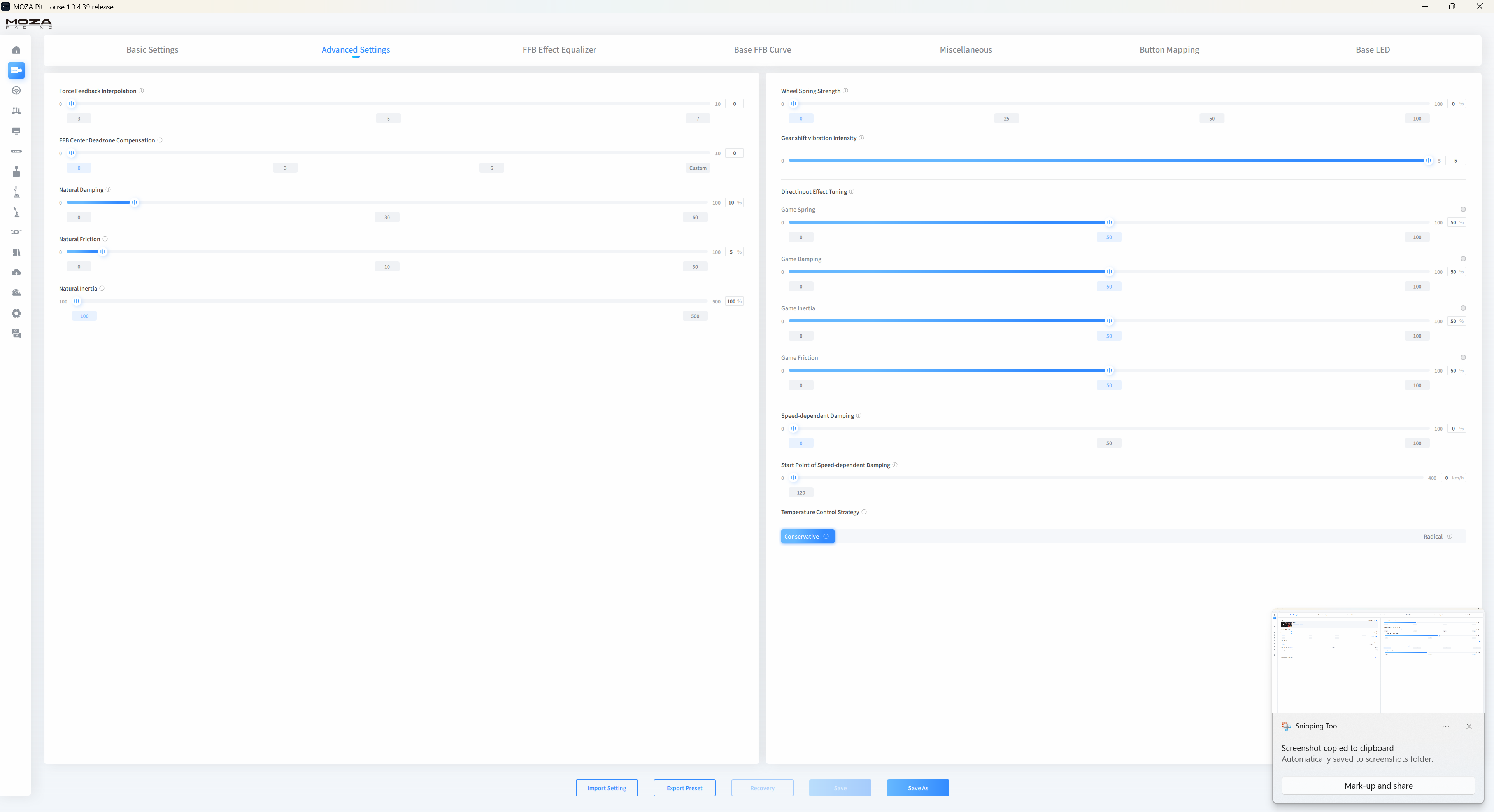
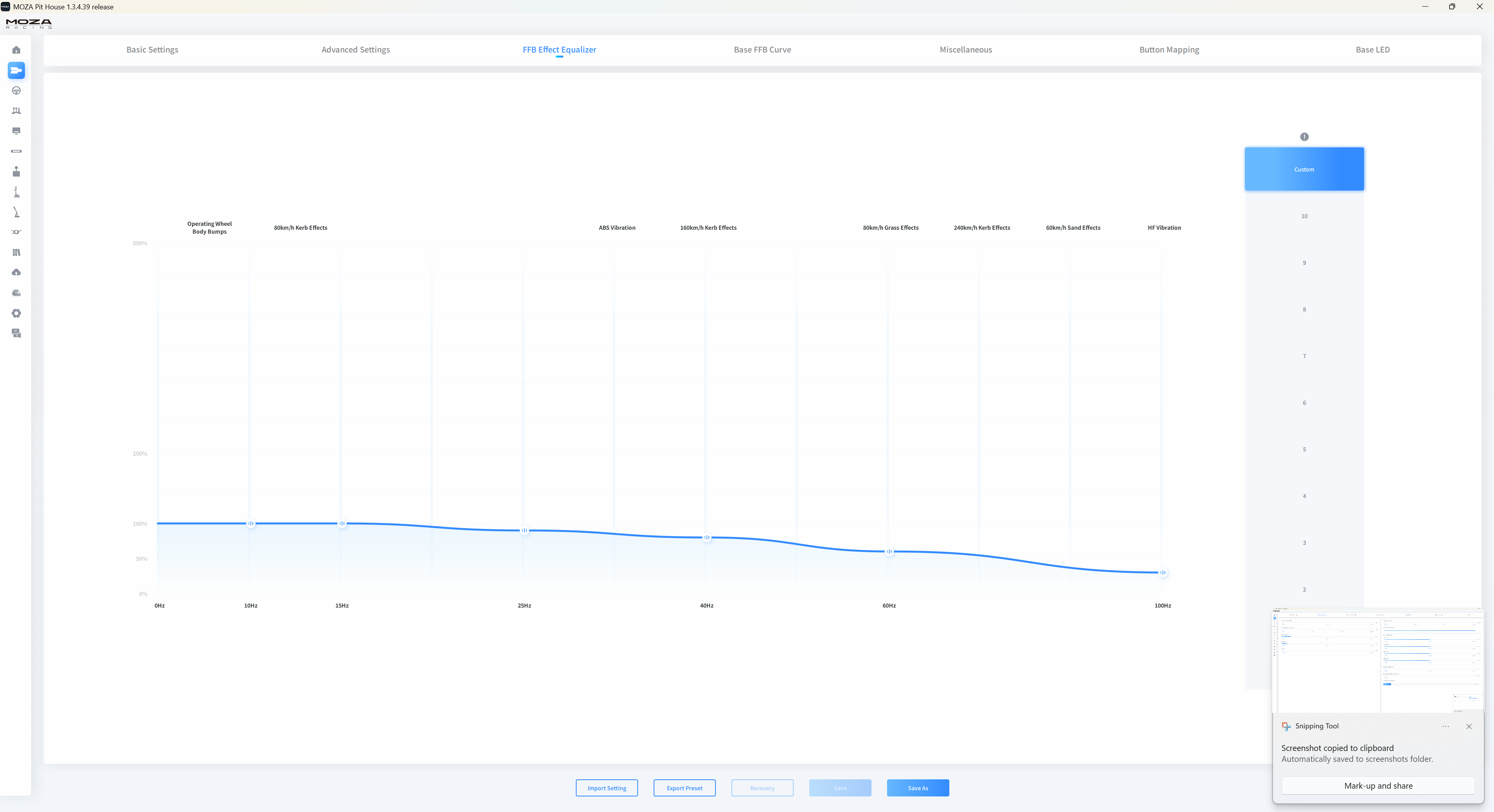
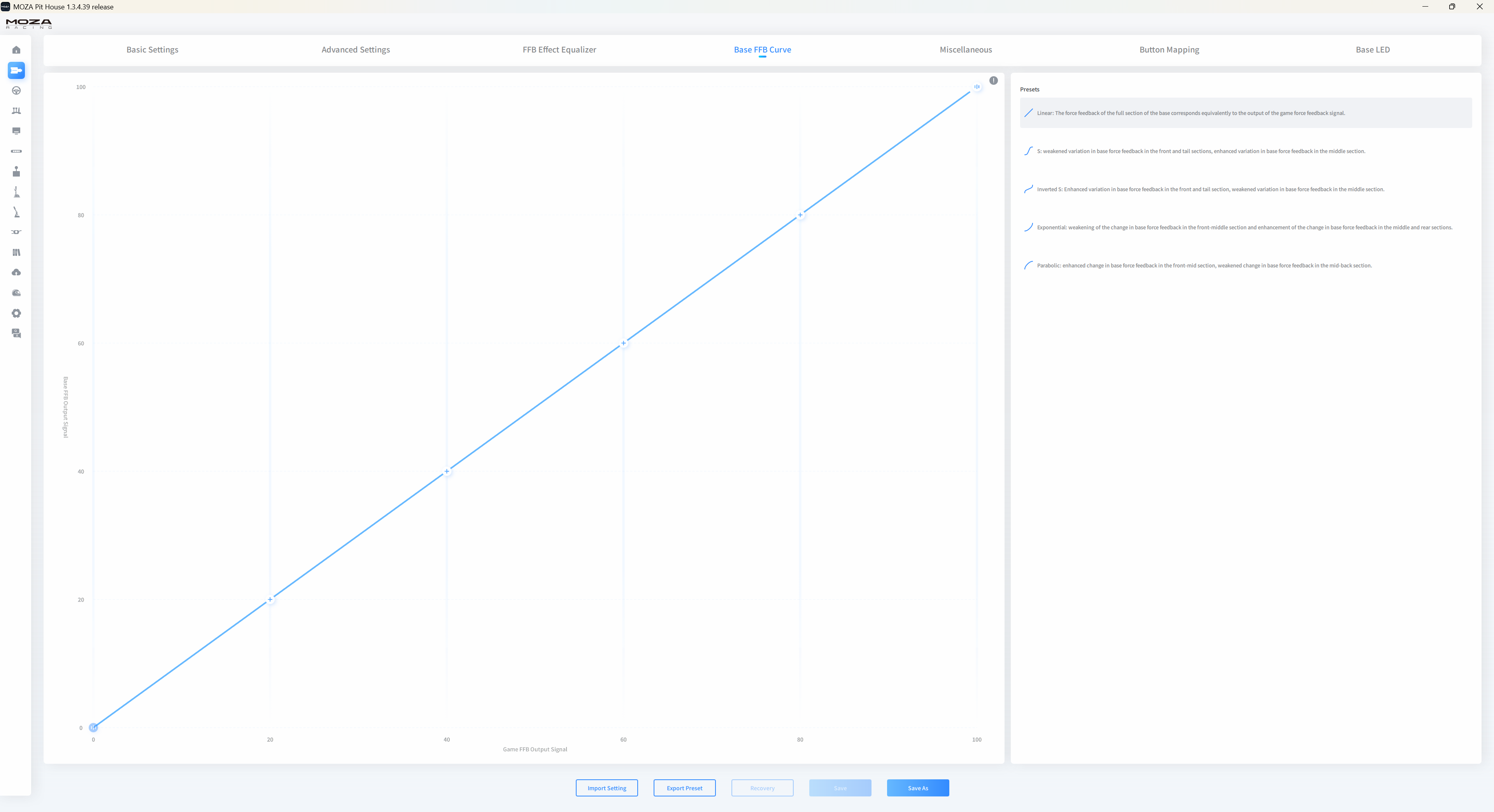
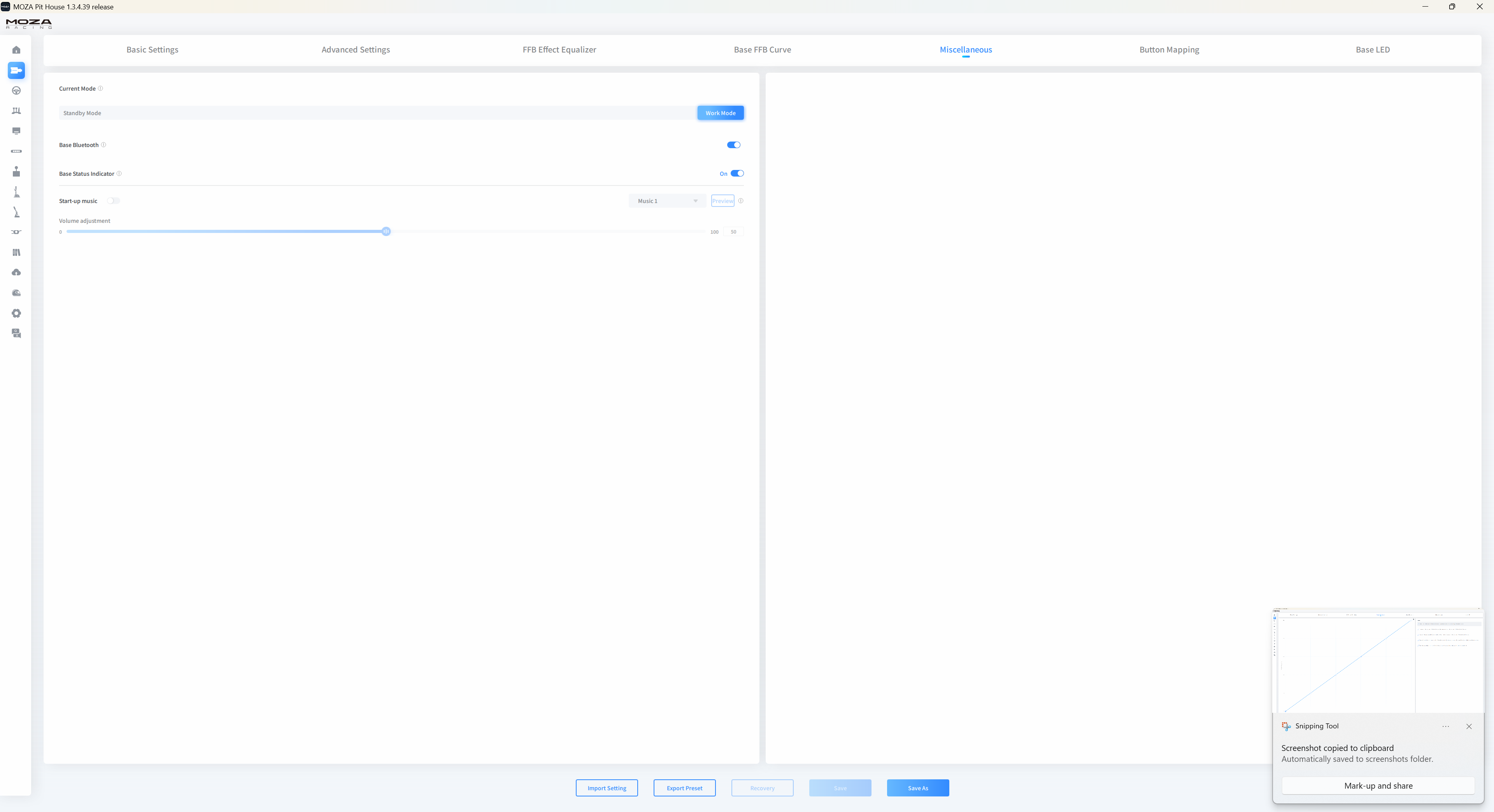
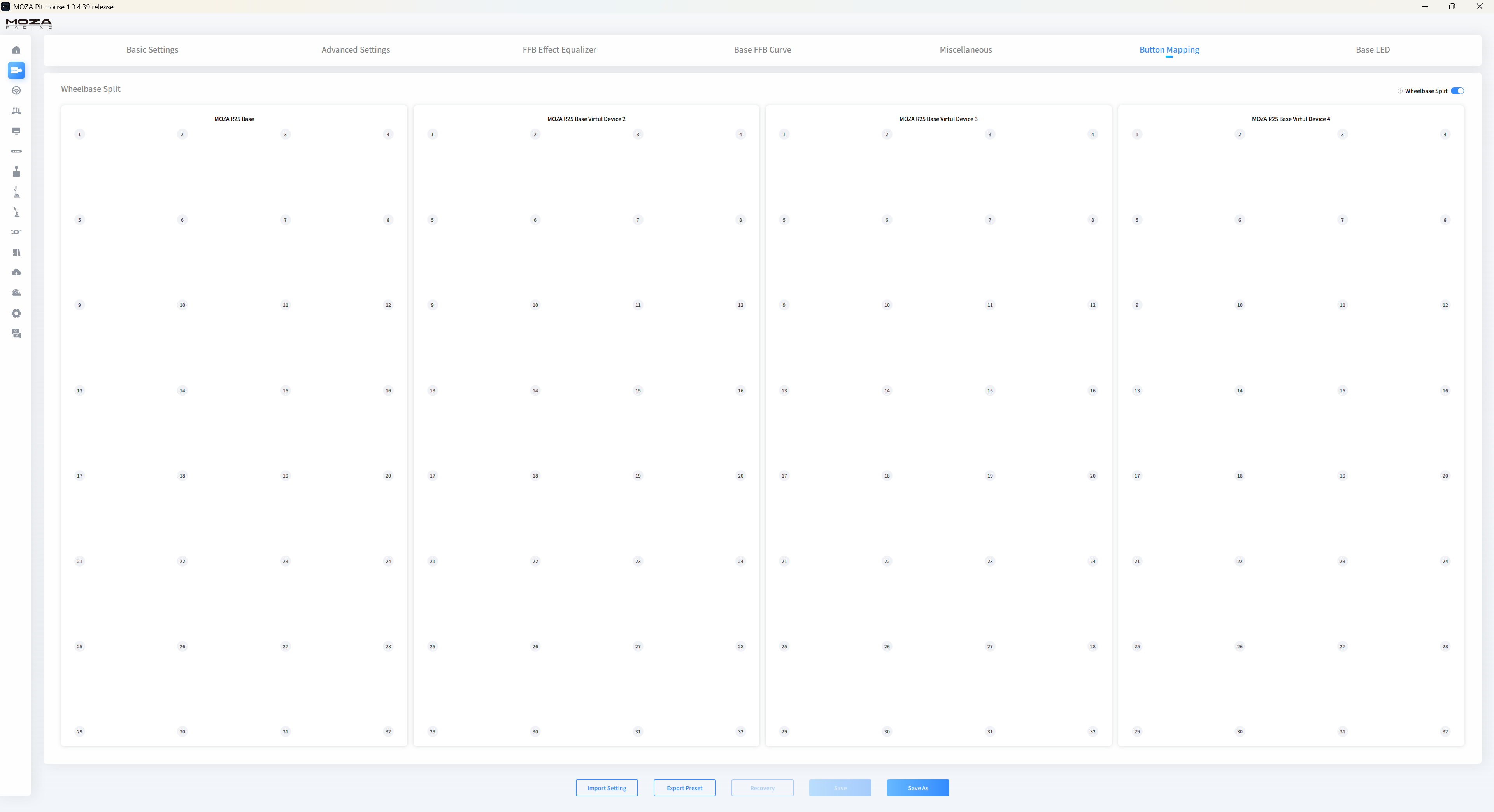
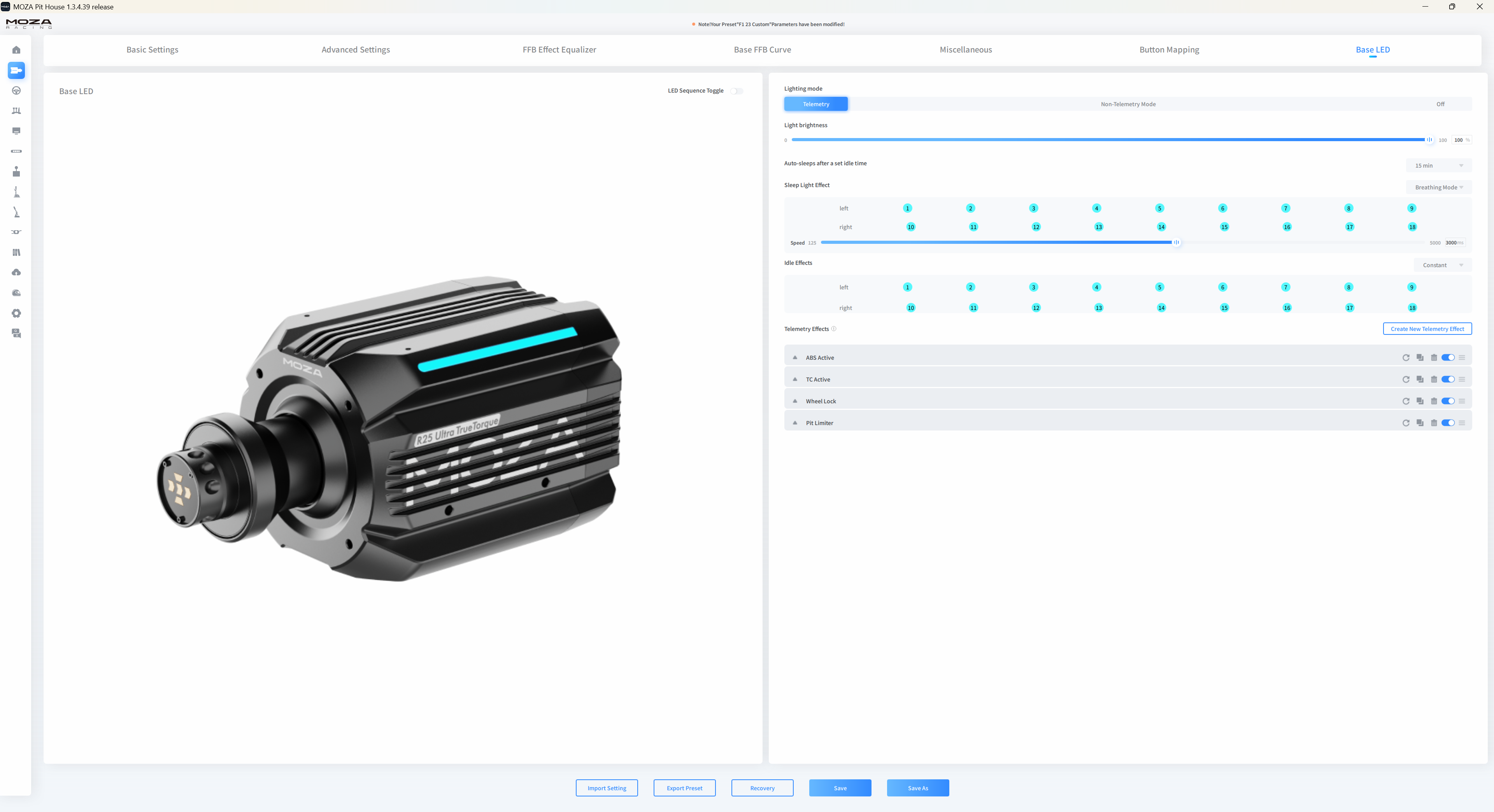
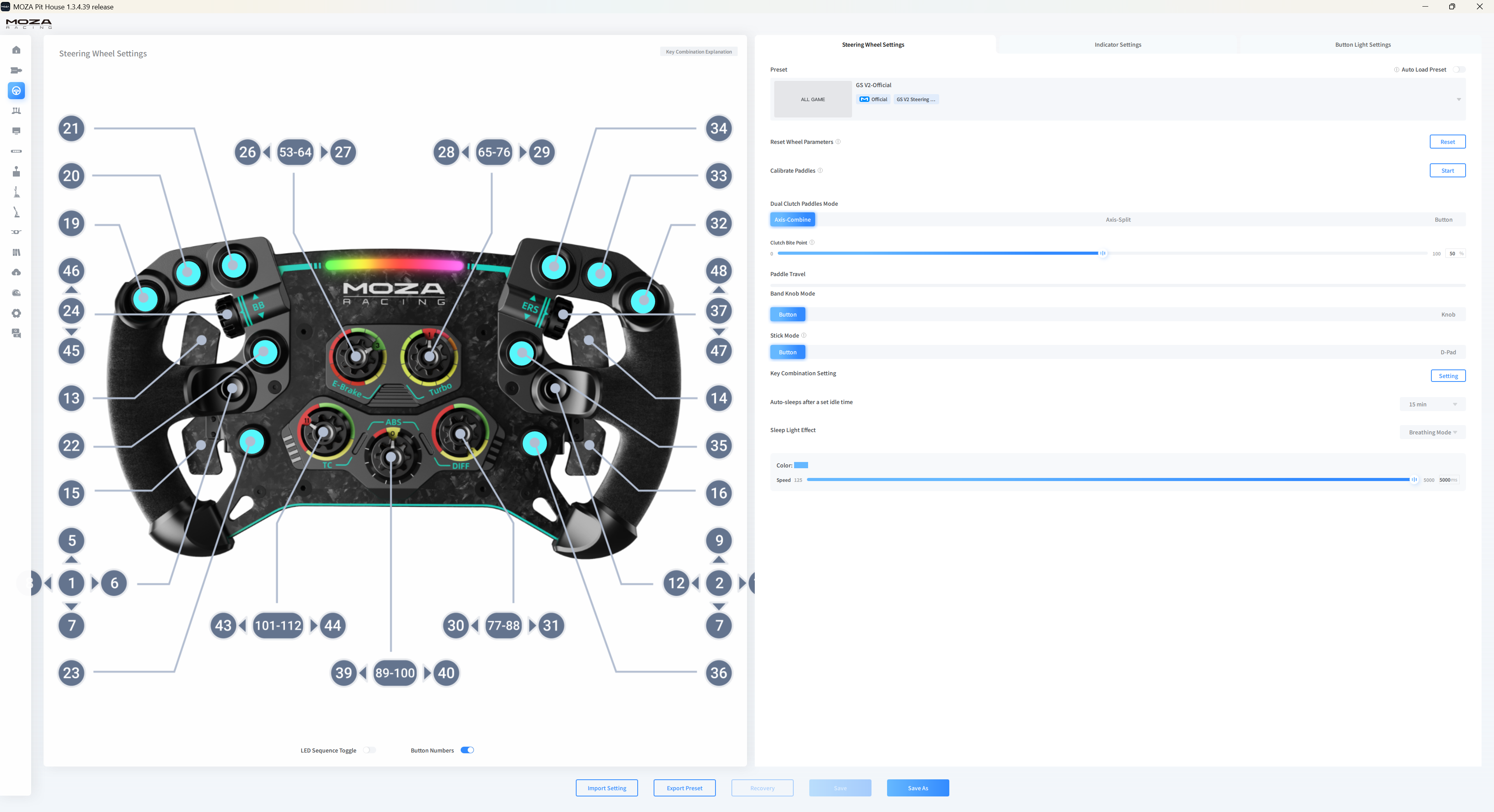
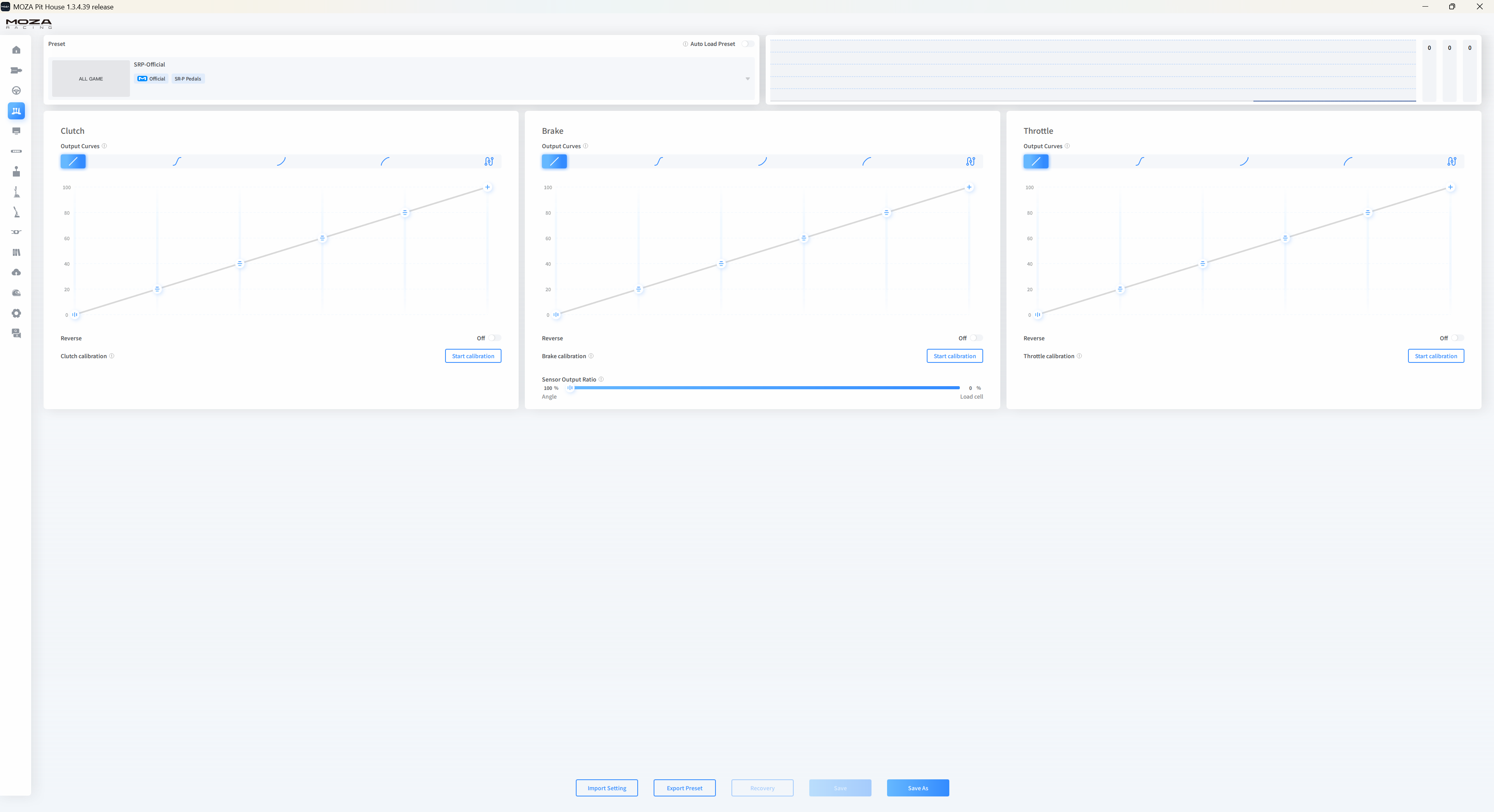
Moza Pit House screenshots – click to enlarge.
Testing with games such as F1 23, F1 25, iRacing, Rennsport, and Assetto Corsa Evo revealed excellent out-of-the-box functionality. Only minor adjustments were needed to optimize force feedback and other settings. For instance, an initial odd sensation in Rennsport was resolved by simply inverting force feedback in-game. Most Pit House modifications involved reducing damping and interpolation to achieve a more direct and connected feel. The software provides sensible presets for popular games, and users can export, import, or share custom configurations, with community support available on platforms like the Moza Discord.
Compared to competing software from Logitech and Thrustmaster, Pit House appears to be the most robust. However, incorporating more detailed tooltips and minor interface reorganization could further enhance its accessibility for new users.
Gaming Performance
Upon installing the Moza R25 Ultra, paired with a GS V2P GT wheel, a long-running F1 23 campaign was completed, along with Assetto Corsa Evo license tests following its 0.4 update.
During an F1 23 campaign session at Suzuka, the combination of the familiar wheel and the more powerful base provided an immediate sense of comfort. Compared to the previously used PXN VD10, the R25 Ultra offered enhanced car control, particularly when driving without ABS and traction control, where sensing traction limits is crucial. Despite F1 23 not being renowned for its clear force feedback, the R25 Ultra facilitated breaking several personal lap records previously set with the Moza R9, Thrustmaster T818, or Logitech Pro Racing Wheel, indicating that the added detail made a significant impact.
The force feedback in AC Evo proved even more impressive. Sensations like the brief weightlessness of the BMW M2 over Mount Panorama’s undulations or the shudder of the Ferrari SF-25 when accelerating aggressively out of corners were exceptionally well-rendered. While kerb effects initially felt somewhat intense, these are easily adjustable in most games or through the Pit House software. Consistent improvements were observed over times set with the PXN VD10, particularly in high-power vehicles like the Ferrari 296 GTB, with the wheel base providing more valuable feedback regarding impending traction loss.
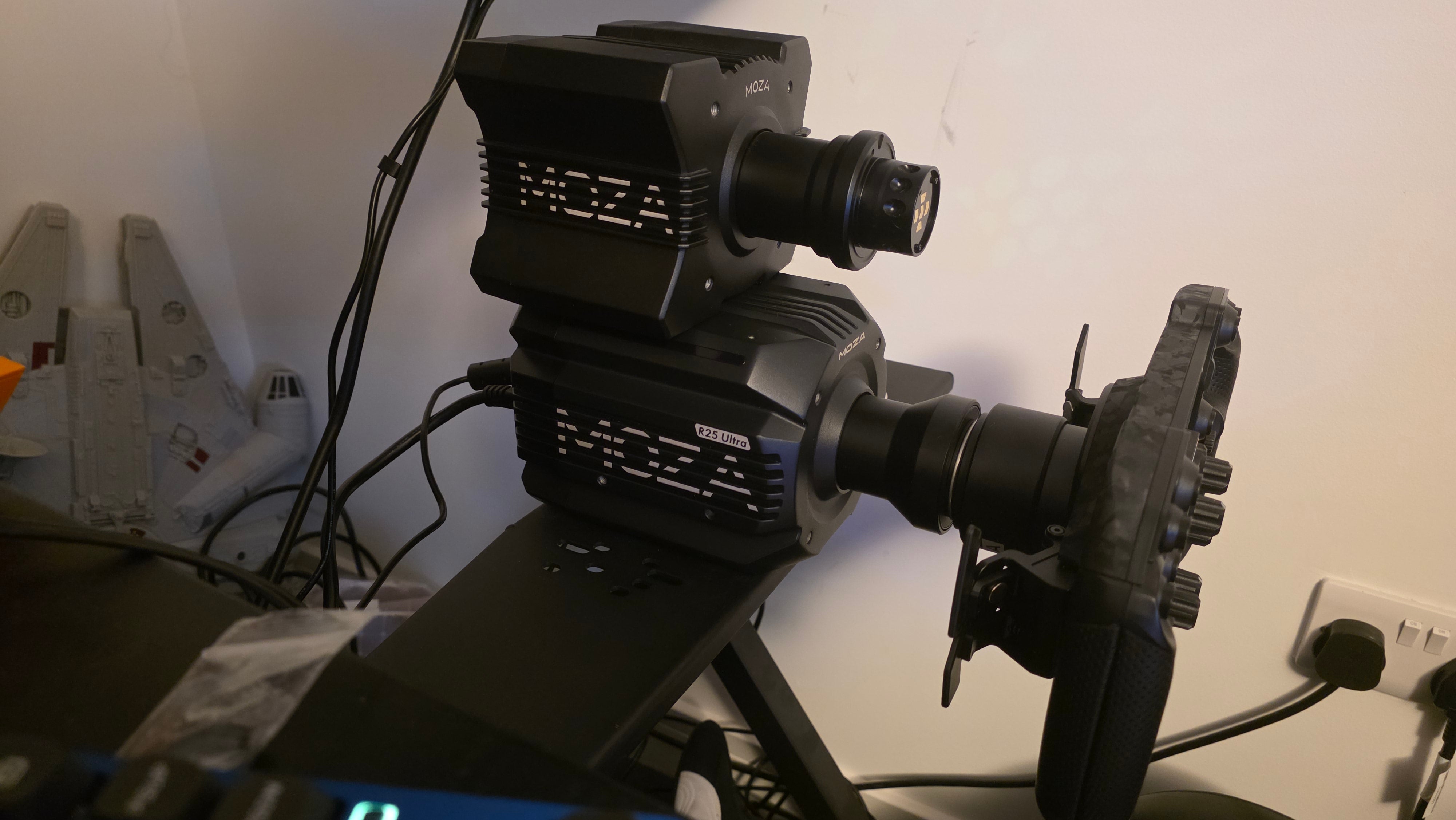
The R25 Ultra is bigger than the R9 used previously, but not by that much – this is a very efficient unit.
Most testing was conducted with the wheel base limited to approximately 80 percent of its maximum performance, equating to 20Nm. This level provided ample immersion in both AC Evo and F1 23. For extended multiplayer sessions or casual play, a lower setting, possibly around 50 percent, would likely be sufficient. The wheel base did not feel dangerously powerful, and its movement was appropriately restricted when hands were intentionally removed. However, the integration of an emergency stop button on the front would be a welcome addition.
Multiplayer races in iRacing and Rennsport revealed the R25 Ultra to be somewhat more aggressive, with a 50 percent power setting feeling more comfortable. In iRacing, where the focus was on track adherence and avoiding collisions, the additional feedback from the steering wheel significantly eased the learning curve for new circuits and cars. The integrated lighting strips proved useful for conveying course conditions, offering visual cues in peripheral vision without diverting attention from the track.
Conclusion
The experience of using the Moza R25 Ultra has been highly enjoyable. The force feedback quality is exceptional, offering rich detail and advanced tuning capabilities. The minimal setup required to achieve an optimal experience across various games is also a significant advantage.
The current Moza ecosystem is robust, demonstrating the company’s successful expansion from value-oriented products to premium offerings. While there might be a limited selection of matching premium Moza wheel rims and no USB passthrough for integrating high-end third-party options, the R25 Ultra combined with the GS V2P GT wheel delivers an outstanding circuit racing experience for its price. Its versatile mounting options, compact power brick, and low-profile design simplify integration into existing setups.
The ability to customize a startup sound for the wheel base, generated by its internal motor, is a unique feature.
.
However, a wheel base providing 25Nm of constant torque may not be essential for most users. While a noticeable improvement in fidelity and power is evident when upgrading from a 10Nm wheel base to the 25Nm R25 Ultra, anything above 15Nm often feels like excessive power for typical use. In such cases, the R21 Ultra at $699, or discounted older R16 and R21 non-Ultra models, might offer better value. The R9, priced at $299, remains a strong budget choice, though it cannot match the R25 Ultra’s level of force feedback detail or intensity.
For those with the budget and an interest in the broader Moza ecosystem—including its wheel rims, pedals, and shifters—the R25 Ultra is highly recommended. It offers exceptional force feedback, user-friendliness, and robust software support.
