

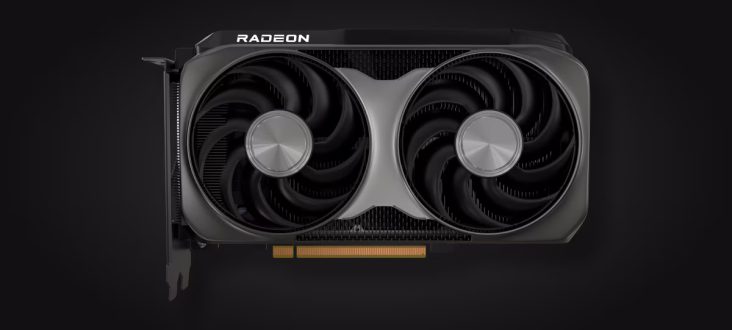
AMD has introduced a new entry-level graphics card, the Radeon RX 9060 XT Low-Power, which utilizes the RDNA 4 architecture. This new version is designed to offer similar core specifications to the standard model but with reduced power consumption.
This graphics card initially appeared on AMD’s China website before being listed globally. Its main distinction is a lower total board power (TBP). The “LP” model consumes 140W, a decrease from the standard Radeon RX 9060 XT’s 160W. This reduction also lowers the recommended power supply unit (PSU) to 450W, making it suitable for pre-built computers with less power capacity.

Despite the lower power draw, the underlying silicon configuration remains unchanged. The card features a die with 29.7 billion transistors, maintaining the 32 Compute Units (CUs) and 2,048 stream processors of its standard counterpart. Its architecture includes 32 ray tracing accelerators, 64 AI accelerators, 128 texture units, and 64 ROPs. This indicates that AMD likely achieved the lower power target by adjusting clock speeds rather than reducing physical cores. The card also comes with 32 MB of AMD Infinity Cache and up to 16 GB of GDDR6 memory on a 128-bit bus, capable of speeds up to 20 Gbps.
The availability of this low-power variant, whether for general retail or exclusively for system integrators, is currently unknown. Since entry-level GPUs do not typically face the same export restrictions as high-end models, it is plausible that this version is a specialized offering designed to optimize performance per watt for particular thermal conditions.
Reducing the TDP by 20W might seem minor, but for small form factor (SFF) builds and original equipment manufacturer (OEM) power supplies, it can be a crucial factor for system stability. The impact of this “LP” designation on gaming performance remains to be seen.
