

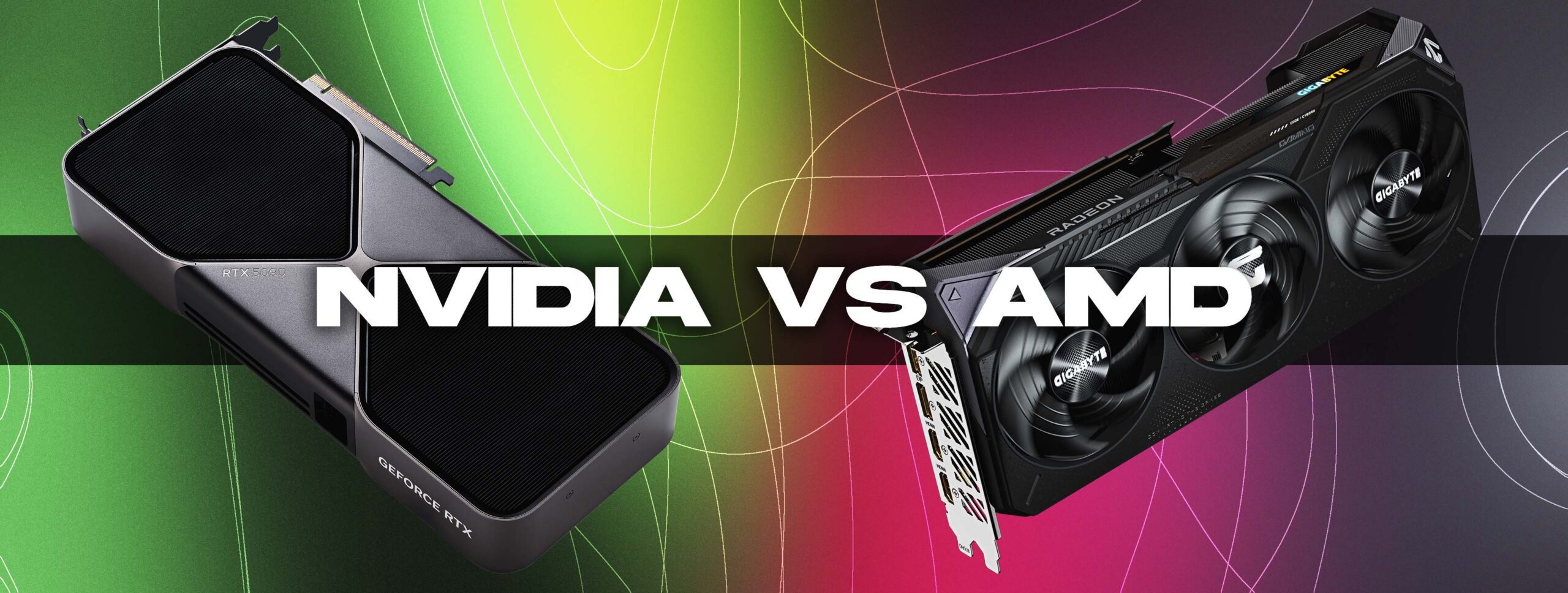
 When constructing or enhancing a gaming or content creation computer in 2025, a common dilemma arises: Radeon or GeForce? As NVIDIA’s RTX 50 Series and AMD’s new Radeon RX 9000 Series become available, the rivalry is more intense and compelling than ever. Both brands offer distinct advantages, and recognizing these distinctions can guide users in selecting the optimal choice for their requirements and financial plan.
Performance and Compute Power
NVIDIA’s RTX 50 Series, featuring models such as the RTX 5090 and RTX 5080, maintains NVIDIA’s reputation for excelling in demanding gaming and professional tasks. These graphics cards utilize the Blackwell architecture, offering more efficient ray tracing, AI-powered rendering, and better power efficiency. The RTX 5090 stands out for its exceptional 4K and 8K performance, making it a preferred option for users and professionals seeking peak capabilities.Conversely, AMD’s Radeon RX 9000 Series, built on the latest RDNA 4 architecture, provides strong rasterization performance, enhanced ray tracing, and increased VRAM across its product range. The RX 9900 XTX, AMD’s leading card, delivers robust 4K gaming performance at a more accessible price point than NVIDIA’s premium offerings. For individuals prioritizing high-resolution gaming without extensive AI functionalities, Radeon GPUs present a compelling value.Regarding compute power for applications such as 3D rendering, AI, and simulations, NVIDIA retains an advantage due to its CUDA cores and broad software ecosystem integration. However, AMD has progressed with OpenCL and HIP support, making its cards more suitable for compute-intensive operations.
DLSS 4 vs FSR 3.1: AI and Upscaling
A key distinction in the Radeon versus GeForce competition involves upscaling and AI-driven frame generation. NVIDIA’s DLSS 4 (Deep Learning Super Sampling) utilizes sophisticated neural networks to enhance lower-resolution frames with impressive visual fidelity. The latest iteration of Frame Generation further improves motion smoothness and responsiveness.AMD responds with FidelityFX Super Resolution 3.1, which enhances visual quality and incorporates Fluid Motion Frames to rival DLSS Frame Generation. Although FSR is compatible with a broader array of GPUs (including older NVIDIA models), DLSS generally maintains superior image quality and consistency, particularly when combined with ray tracing.
G-Sync vs FreeSync: Adaptive Sync Technologies
Adaptive sync technology is another significant consideration in choosing between Radeon and GeForce. NVIDIA’s G-Sync provides outstanding performance and visual quality, though it usually necessitates pricier monitors. AMD’s FreeSync is broadly supported by both affordable and high-end displays, integrating smoothly with Radeon graphics cards.Fortunately, NVIDIA GPUs now support numerous FreeSync monitors through G-Sync Compatible certification, reducing previous limitations. Nevertheless, Radeon continues to provide more extensive adaptive sync compatibility.
Radeon vs Geforce: Software, Drivers, and Ecosystem
NVIDIA’s GeForce Experience maintains a polished interface for automated driver updates, game optimizations, and straightforward streaming and recording. AMD’s Adrenalin Edition software has also evolved, providing detailed performance adjustments, integrated recording, and features such as Radeon Chill and Boost.While AMD’s driver stability has improved, NVIDIA generally retains a reputation for more reliable day-one support, especially for significant game launches and professional applications.
Final Verdict: Radeon vs GeForce in 2025
Considering the Radeon versus GeForce competition, which GPU is the right choice?
-
NVIDIA RTX 50 Series is suitable for users who prioritize superior ray tracing, advanced AI capabilities like DLSS 4, and peak performance, even with a higher investment.
-
AMD Radeon RX 9000 Series is ideal for those seeking robust gaming performance, greater VRAM value, and wider compatibility with FreeSync monitors, particularly for 1440p and 4K resolutions.
