

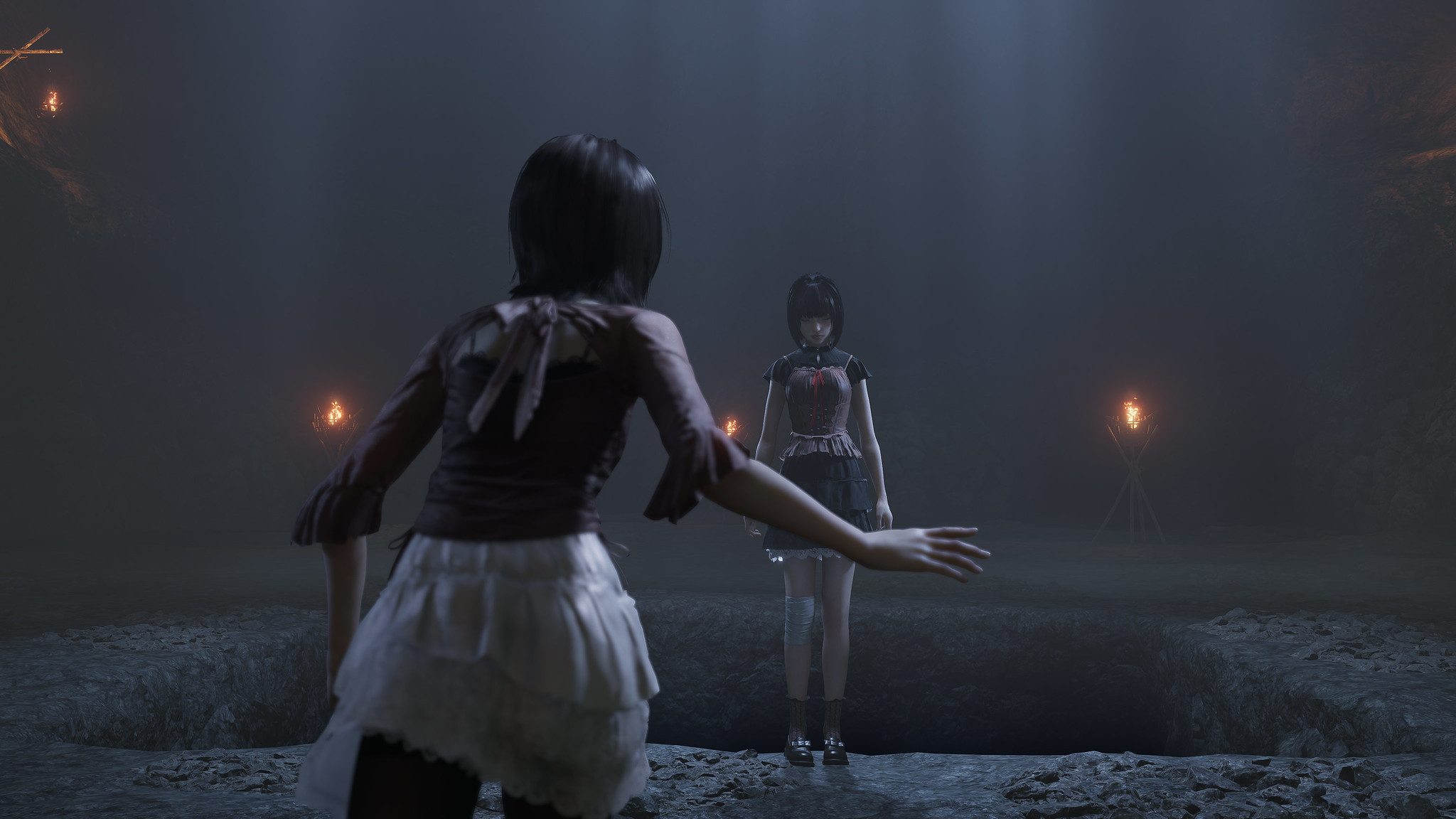


Following the remasters of Fatal Frame: Maiden of Black Water and Fatal Frame: Mask of the Lunar Eclipse, Koei Tecmo and Team Ninja embarked on a complete remake of the acclaimed survival horror title, Fatal Frame II: Crimson Butterfly. The goal was to retain the essence of the PlayStation 2 original while enhancing it for contemporary players.

Directors Hidehiko Nakajima (action gameplay) and Makoto Shibata (story) shared insights into recreating the game’s eerie ambiance, introducing new mechanics, and overcoming development hurdles for its March 12 release on PlayStation 5.
What made the original game a fan favorite?

Shibata believes the game’s popularity stemmed from its evolution of the first Fatal Frame’s concepts, with a stronger focus on narrative. This approach crafted a frightening yet captivating experience, encouraging players to explore its beautiful and terrifying world to completion.
How did the PlayStation 2’s capabilities influence the original Fatal Frame II’s design and visuals?
Shibata explained that the hardware’s specifications and rendering power were utilized to portray spirits as semi-transparent and distorted. The ability to apply screen-wide filters, adjusting elements like noise, contrast, and color tones at minimal processing cost, was crucial for achieving visuals akin to old film.
What core elements of the original were essential to preserve in the remake?
Shibata stated that the primary focus was on the protagonist’s actions and the Camera Obscura combat. With the world and story remaining intact, the emphasis was on player interaction within that world.
Visually, atmosphere is paramount. Meticulous adjustments to lighting, shadows, fog, and effects create a humid, unsettling setting where spirits seem imminent. Exploration within this atmosphere is central to the series, as is the background music, which features barely audible or ambiguous sounds.

Nakajima added that the core experience involves fighting and exploring through photography with the Camera Obscura. While new features and combat rule adjustments have been made, the fundamental concept of confronting and defeating fear by photographing it is unchanged. The straightforward controls for taking pictures persist, but players can now engage more proactively and use advanced photography techniques, rather than just waiting for enemy attacks. Similarly, exploration is designed to encourage players to naturally observe and photograph their surroundings.
How have the gameplay systems been modernized?
Nakajima detailed several improvements for a more intuitive and comfortable experience. The original game featured a fixed camera perspective, but the remake positions the camera closer to the player character, enabling free movement and exploration within Minakami Village. This closer view significantly boosts immersion. Beyond just camera and control changes, the gameplay itself has been restructured to align with these updates.
Shibata acknowledged past feedback regarding controls and stated that Team Ninja, as the developer, committed to significant improvements from the start. Motion matching proved particularly challenging, involving extensive trial and error to refine responsiveness and enhance the variety and believability of character movement.
What new features have been added to the Camera Obscura?
Nakajima explained that to make the Camera Obscura feel more like a real camera or gadget, new mechanics like focus, zoom, and filters were introduced. Focus and zoom operate similarly to a standard camera, while filters alter the Camera Obscura’s offensive capabilities when activated.

For instance, in combat, the Paraceptual Filter extends attack range and can obscure enemy vision, while the Exposure Filter allows for quicker shots and can slow enemy movement. During exploration, the Camera Obscura can also track the shadows of missing individuals or restore vanished objects.
How does the new Willpower system function?
Shibata described the Willpower system: it depletes when the player runs during combat, or is touched or attacked by spirits. If Willpower is fully depleted, the protagonist collapses, becoming overwhelmed by spirits, leading to a critical state. It can be restored by holding hands with Mayu or by using specific items.
How do characters interact with the environment in new ways?

Nakajima highlighted the addition of physical behaviors and environmental interaction. As players navigate the environment, background objects can be touched, shaken, or even collapse, enhancing realism and immersion. Spirits are also capable of interacting with and moving objects.
How do PlayStation 5 features enhance the game’s atmosphere?
Shibata emphasized that uninterrupted tension is vital in horror games. The PS5’s SSD enables fast data loading, crucial for sustaining fear. Furthermore, in the Fatal Frame series, each spirit produces distinct sounds based on its location. The 7.1.4-channel 3D audio allows players to precisely pinpoint spirit positions while also conveying Minakami Village’s eerie ambiance through sounds like rustling trees and subtle wind whispers.
What additional information should fans know?
Nakajima clarified that the remake is not merely a recreation; it expands upon the original with extra side stories and new areas. In addition to the original ending, a special new ending has been included, featuring a newly composed song, “Utsushie,” by Tsukiko Amano.

The game is designed to be accessible for new players while offering a fresh experience for long-time fans. Players are encouraged to enjoy discovering the new ending and all the other features this remake provides.
The haunted Minakami Village will be available through this new PS5 experience when Fatal Frame II: Crimson Butterfly launches on March 12.
