
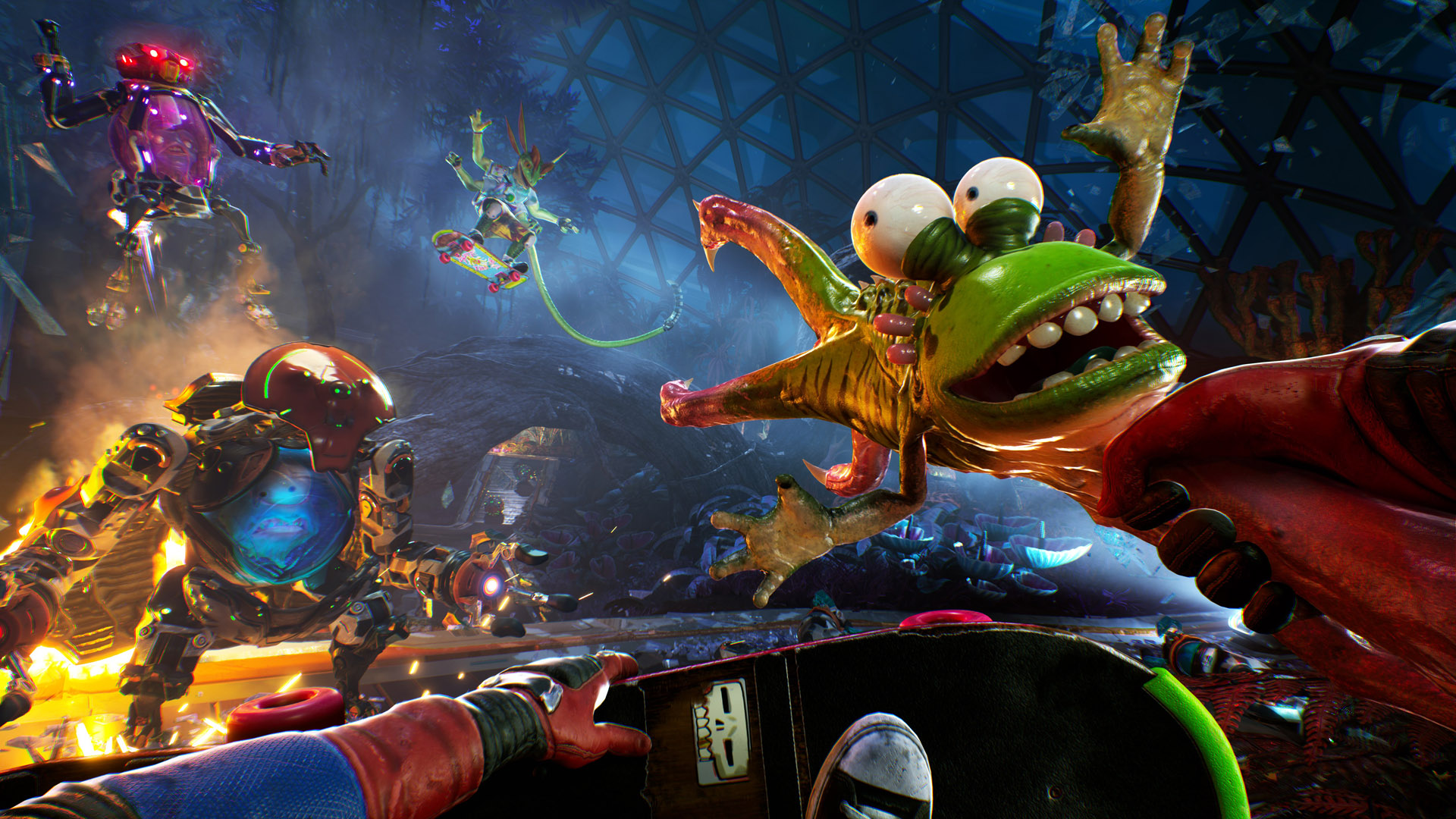
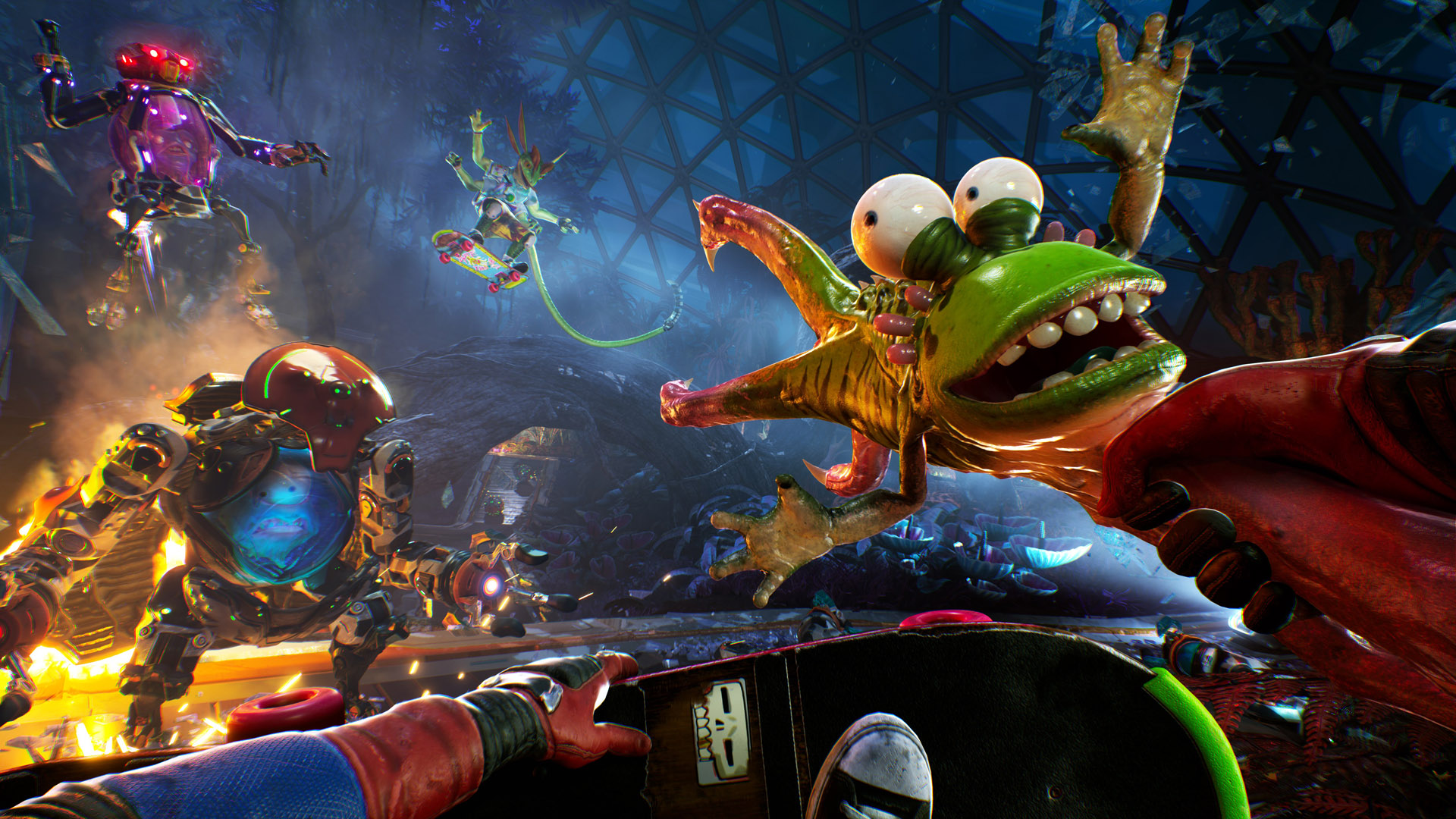
The integration of skateboarding into High On Life 2 has impressed players, capturing the essence of the sport within a first-person shooter. While taking some liberties, the mechanics feel authentic to skating game fans, even from a different perspective and genre. With meticulously placed skateable objects and engaging first-person shooting featuring the humorous Gatlians, this mechanical change provides High On Life 2 with a truly unique feature, a concept rarely explored by developers.
This also contributes to High On Life 2 feeling like a much faster game than its predecessor. By essentially replacing the sprint button and increasing overall agility, the skateboard acts as an indispensable tool, allowing players to grind on rails, jump over objects, or even use it as a projectile against enemies.
With the game’s release approaching, Chief Design Officer Erich Meyr discussed how the idea behind incorporating skateboarding as a traversal and combat mechanic in a first-person shooter originated. It turns out this concept had been considered by the team even before the first game’s release.
“The earliest inspiration for the skateboard came back in High On Life when Concept Artist Sean McNally drew the bounty hunter riding a roly-poly type of alien,” Meyr explained. “Unfortunately, a level-specific mechanic like that wasn’t in the timeframe for the first game, but good ideas tend to persist. When brainstorming for High On Life 2, the idea resurfaced, and the team thought it would be even better as a normal skateboard that helps ground the character as an Earthling.”
Parkour!
Skateboarding has become deeply embedded in the world of gaming over the years, with numerous Tony Hawk titles, the return of Skate, and indie games like Session or Skate Bird offering their unique takes on the genre. Now, High On Life 2 is developing this as a first-person experience, drawing inspiration from both past and present games to ensure its distinctiveness. Interestingly, one significant inspiration is not technically a skateboarding game at all.
Members of the development team had previously worked on Sunset Overdrive at Insomniac Games. While first-person skating differs from Sunset Overdrive’s grind-heavy parkour, there was a desire to capture a similar environmentally driven flow. During work on Sunset Overdrive, traversing across Sunset City was a captivating experience, often leading to exploration rather than using developer shortcuts. When seriously considering a skateboard for High On Life 2, the aim was to achieve that same feeling, even if it meant expanding the skateboard’s role significantly.
To delve into the classics, the team analyzed many Tony Hawk games to determine what would translate well (and what wouldn’t) for first-person skateboarding. For instance, Tony Hawk’s controls do not directly work as an FPS, but they served as a baseline inspiration for what skating should feel like. This analysis prompted thoughts about incorporating vert ramps, half pipes, and grinds. The team also played a lot of Session, though its highly technical nature meant a much more simplified control scheme was needed for High On Life 2, without its complex trick system.
Finding Inspiration from Indies
During the research and conceptualizing phase for High On Life 2, Meyr was surprised to find almost no first-person skating games available, beyond some mods for Skate. Then, an indie game called Griptape Backbone was discovered. “It’s very chill and dreamy and got the team thinking about how to cheat the board placement so it’s more visible in first person and helps ground the player.”
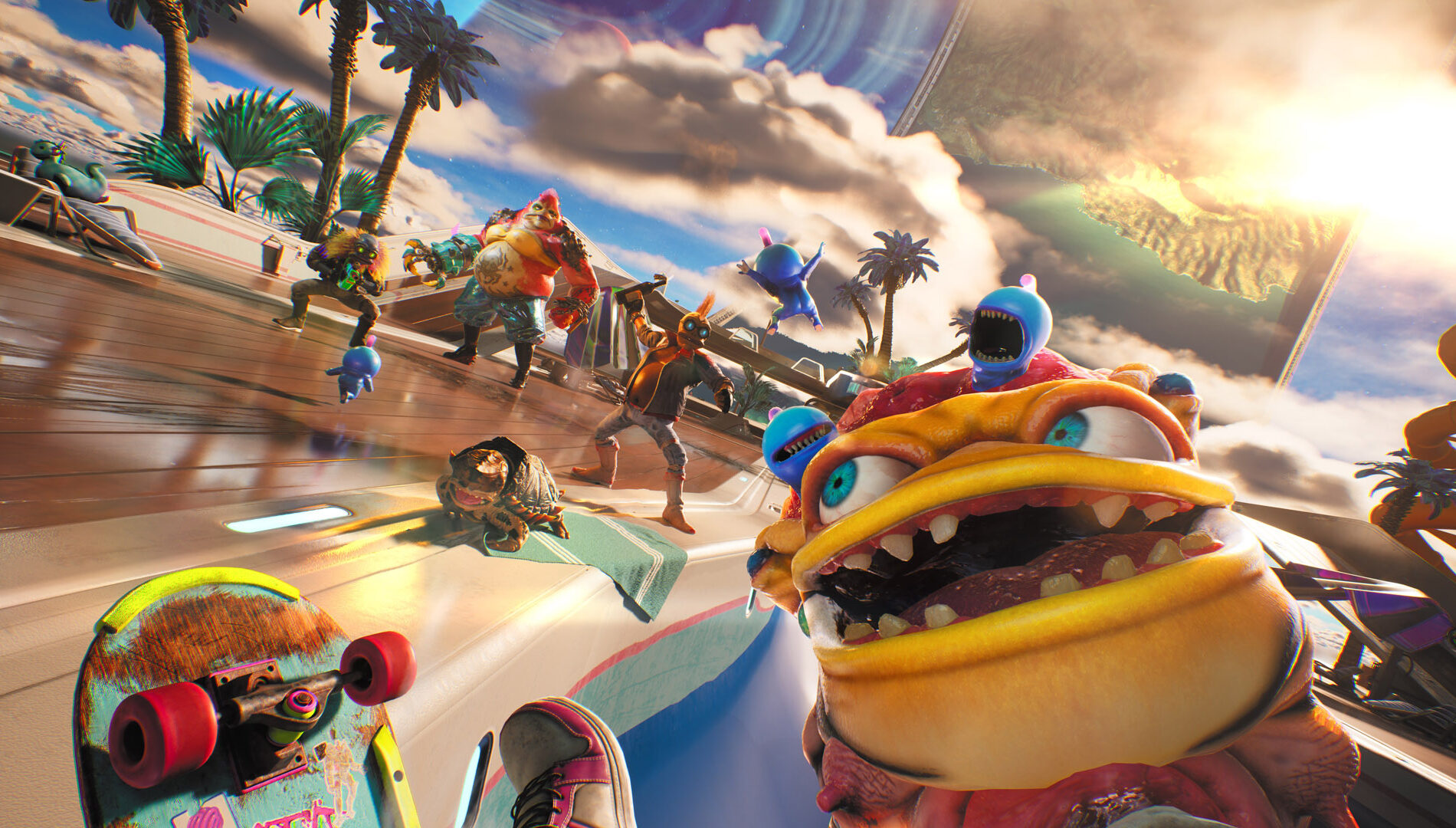
“When development was nearing its final year, [open world FPS] Echo Point Nova was released. Playing it was enjoyable, and the simple replacement of sprinting with a hoverboard was appreciated. That same philosophy was applied to High On Life 2 (deciding which button to assign the skateboard to had been a challenge), making combat on and off the board feel seamless. Thus, inspiration was drawn from many different games throughout the process. While these inspirations were great references, the final implementation relied on clever engineering, solving numerous design problems, fine-tuning controls, and extensive playtesting.”
Once it was decided that skateboarding would be a key feature for the next game, the team began to tackle High On Life 2’s unique challenge: blending skating and shooting to create an enjoyable experience. One of the largest debates among the team, as Meyr explained, was whether the player’s aim should be independent of their movement direction while on the skateboard.
“For a long time, players could look in any direction while skating, which felt very natural and allowed for crazy moves like circling enemies while shooting and skating backwards while still fighting,” Meyr stated. “However, in playtesting, it meant constantly needing to create larger and sparser arenas to prevent players from running into objects because they weren’t looking where they were going!”
Ultimately, the team decided to lock the player’s movement to their viewpoint while skateboarding but allowed free look while grinding objects. This effectively means skating is for positioning, and grinding is for combat. This simple change significantly improved navigation and the skateboard’s overall usability in combat. Experiencing a few levels in High On Life 2 confirms the effectiveness of this trade-off, as players would likely collide with numerous walls and objects without proper directional focus.
This design choice is partly due to the skateboard’s speed, which allows for rapid traversal across large sections of a level, unlike most FPS games. It introduces a major new dimension to combat. However, given the game’s compelling and humorous story with many performances to capture, players could accidentally skip past characters or dialogue if not facing the right way. Meyr discussed how the team addressed this challenge, even in moments without a narrative beat.
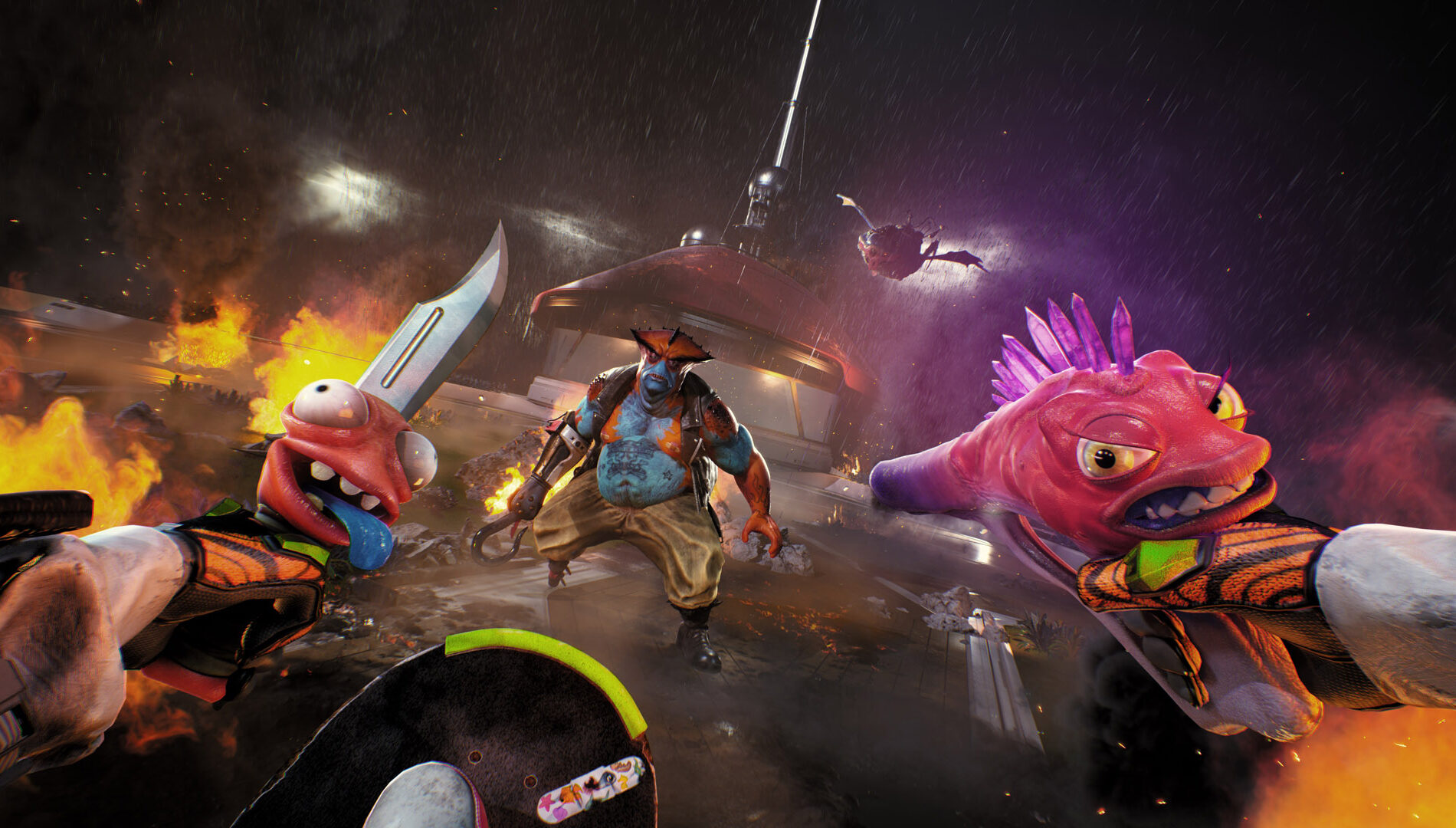
“Firstly, it made storytelling harder as players can now fly past everything as fast as they want! The team had to get clever about how to funnel players into important moments to give them time to notice them,” Meyr explained. “But aside from that, it was also a fun challenge to figure out what kinds of city objects make natural skate elements. One memorable moment was when someone placed a big octopus mascot in the middle of the city, and the team realized, ‘Hey, this is great, but it needs to work with the skateboard because every single player is going to grind on that.’ Then its brain was exposed as a bouncer to launch players incredibly high. There’s no real story there, just a love for making stupid things fun.”
Ride, Shoot, Have Fun, Repeat
Balancing that fun with a well-paced game was another element the team addressed when determining the skateboard’s influence on High On Life 2’s overall design and pacing.
“In the first game, gameplay typically cycled between traversal, combat, and narrative beats. The skateboard fit pretty easily into the traversal piece of that formula,” Meyr explained. “Skating significantly influences the combat aspect of the game, but it was not allowed to dominate. Ultimately, the goal was for the game to retain much of what makes a traditional shooter enjoyable. The team did not want the skateboard to muddy the FPS experience by requiring excessive aim assist or allowing movement so fast that enemies would need extreme adjustments to keep up.”
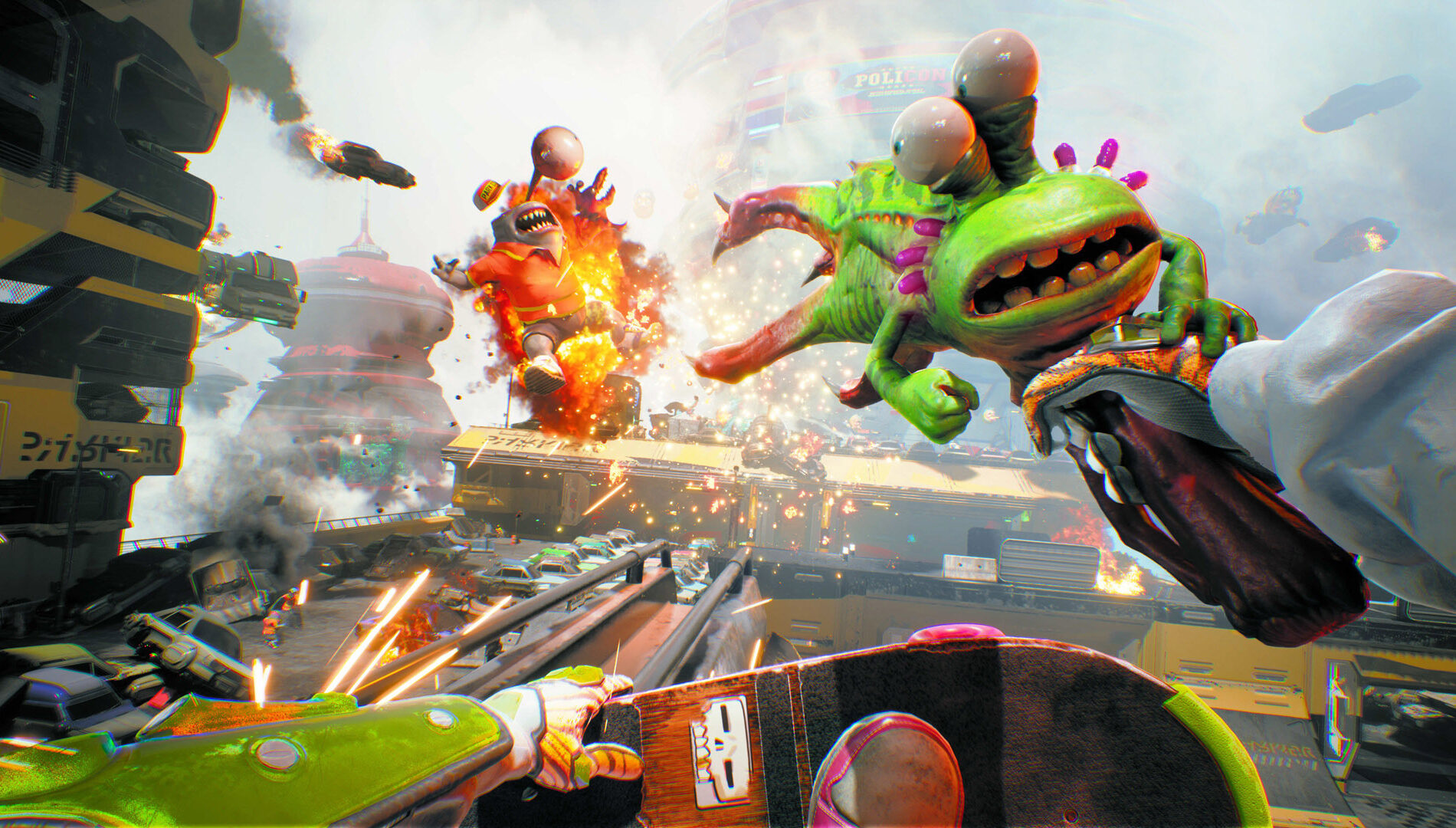
The game quickly introduces players to the board, and soon they are combining skateboarding and shooting in High On Life 2, such as sliding across powerlines while dispatching alien goons in the opening zoo level. The skateboard never feels like it hinders the shooting; instead, it enhances it, encouraging players to integrate it into their ability to reach alien foes on rooftops who would otherwise be inaccessible.
The first game already featured significant verticality and unique traversal elements thanks to Gatlians like Knifey and their grapple ability, but the skateboard further intensifies that ambition. Grinding, riding in sewer pipes, and wall riding all create opportunities for unexpectedly complex riding options within the environment. Every level offers unique chances to test skills, such as navigating across a mix of floating rails and pools, giant balloons to bounce on, and other quirky obstacles while traversing the planet ConCon.
Board riding can also be crucial, as demonstrated in some boss fights. Against the bounty hunter Sheath, the battle took place in a large room with slanted quarter-pipes running up the walls, providing ample opportunities for continuous movement while dealing damage. Similarly, fighting Brutakis, the mini-boss of MurderCon, felt like navigating a skatepark with numerous ramps, rails, and stairs. This design appears purposefully intended to keep players moving, fostering a natural sense of fun and flow in combat.
Letting Go of Your Hands
Teaching a new mechanic to a player while maintaining game momentum is always a delicate balance. Initially, the team conducted many “hand-holding tutorial” tests for the skateboard, which proved to be a poor experience. Ultimately, the tutorials were pared back to cover only the essentials, allowing players to grasp and experiment with the mechanics at their own pace.
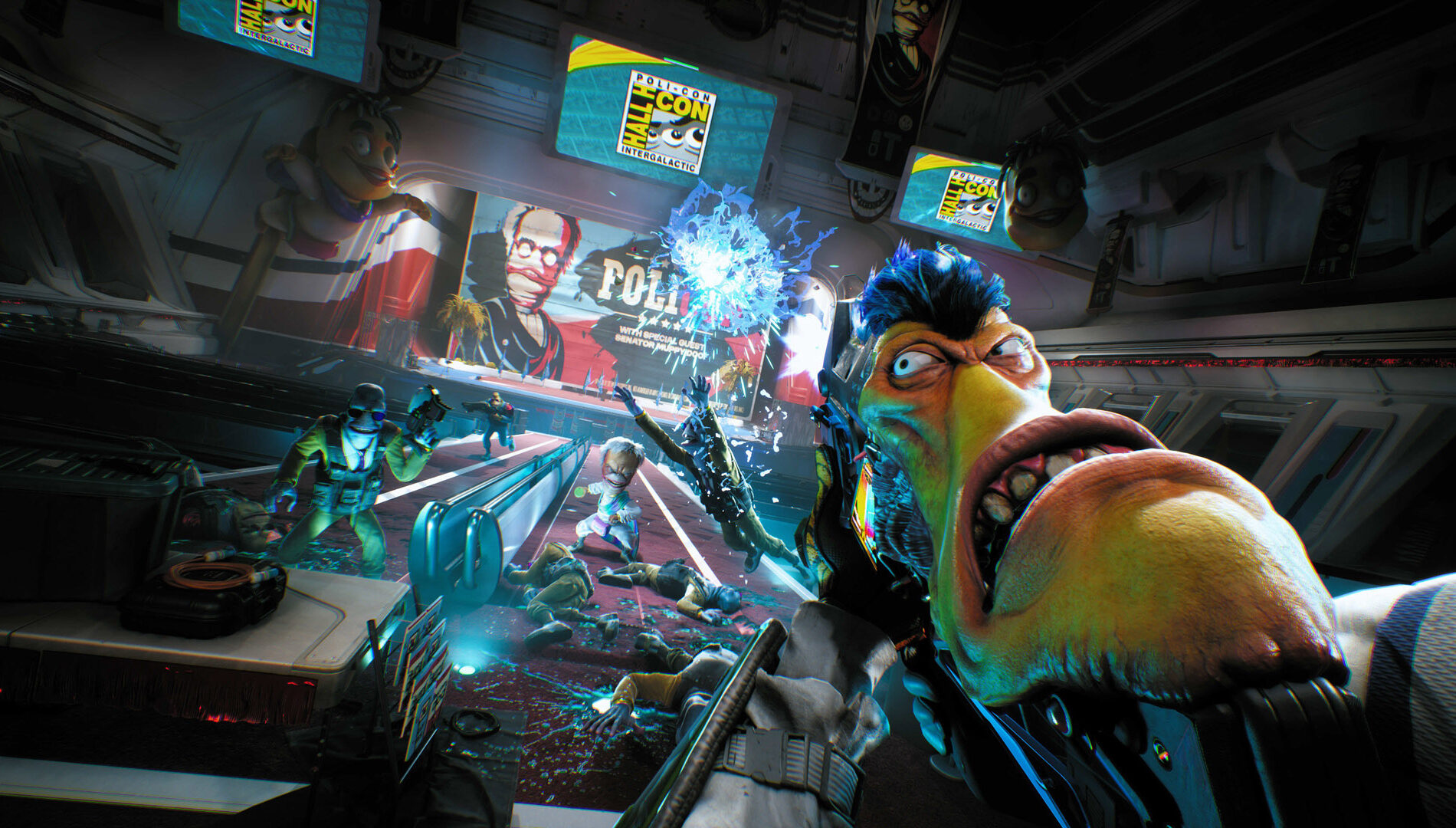
“There are elements to the skateboard that are not taught upfront, allowing players to discover them on their own, then reinforced in later levels,” Meyr stated. “By that point, players may have already figured them out and won’t even notice the tutorial, or they will learn them there and realize, ‘Holy crap I could have been doing this the whole time, I need to go back and try this in the city!’”
Meyr noted that during playtesting, he was relieved to see the concept embraced by the internal team. “A concern was that leaning fully into skating might necessitate sacrificing some core FPS elements, but it turned out that treating the skateboard as an extension of sprinting naturally helped balance the two. The enthusiasm for using the skateboard in combat was also delightful. The team developed features like bailing on the board and having it fly to hit enemies, and playtesters immediately wanted to bounce on enemies’ heads and bash into them. All of that was implemented! It will be interesting to see if players can beat the game using only the skateboard once it is obtained.”
Through continuous iteration and a passion for skateboarding, the team at Squanch Games has not only built upon the success of their first game but also pushed to introduce something entirely unique to its sequel – all while performing kick-flips over aliens. The game launches on February 13, 2026, when High On Life 2 becomes available for Xbox Series X|S, Xbox on PC, and day one with Game Pass Ultimate, supporting Xbox Play Anywhere.
