

Redefining Local AI Performance
The shift in AI development from cloud to local systems has highlighted a major obstacle for professionals: video memory. Contemporary large language models (LLMs) such as DeepSeek R1, Mistral 3.1, and Flux.1 often demand over 20GB of VRAM for optimal operation. Consumer-level GPUs, typically offering 16GB or less, frequently struggle, resulting in slow performance, model compatibility issues, or reliance on slower system memory.
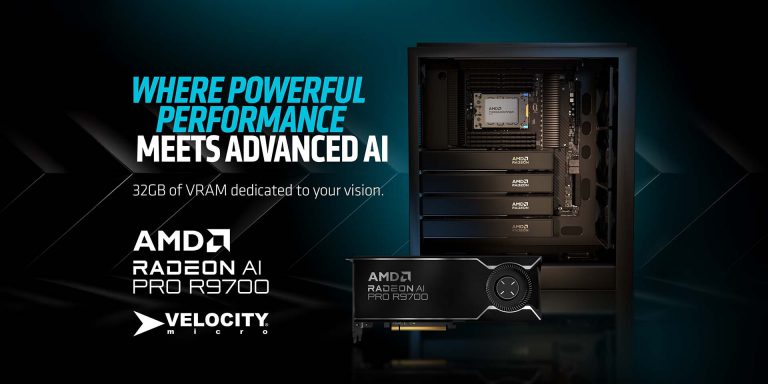
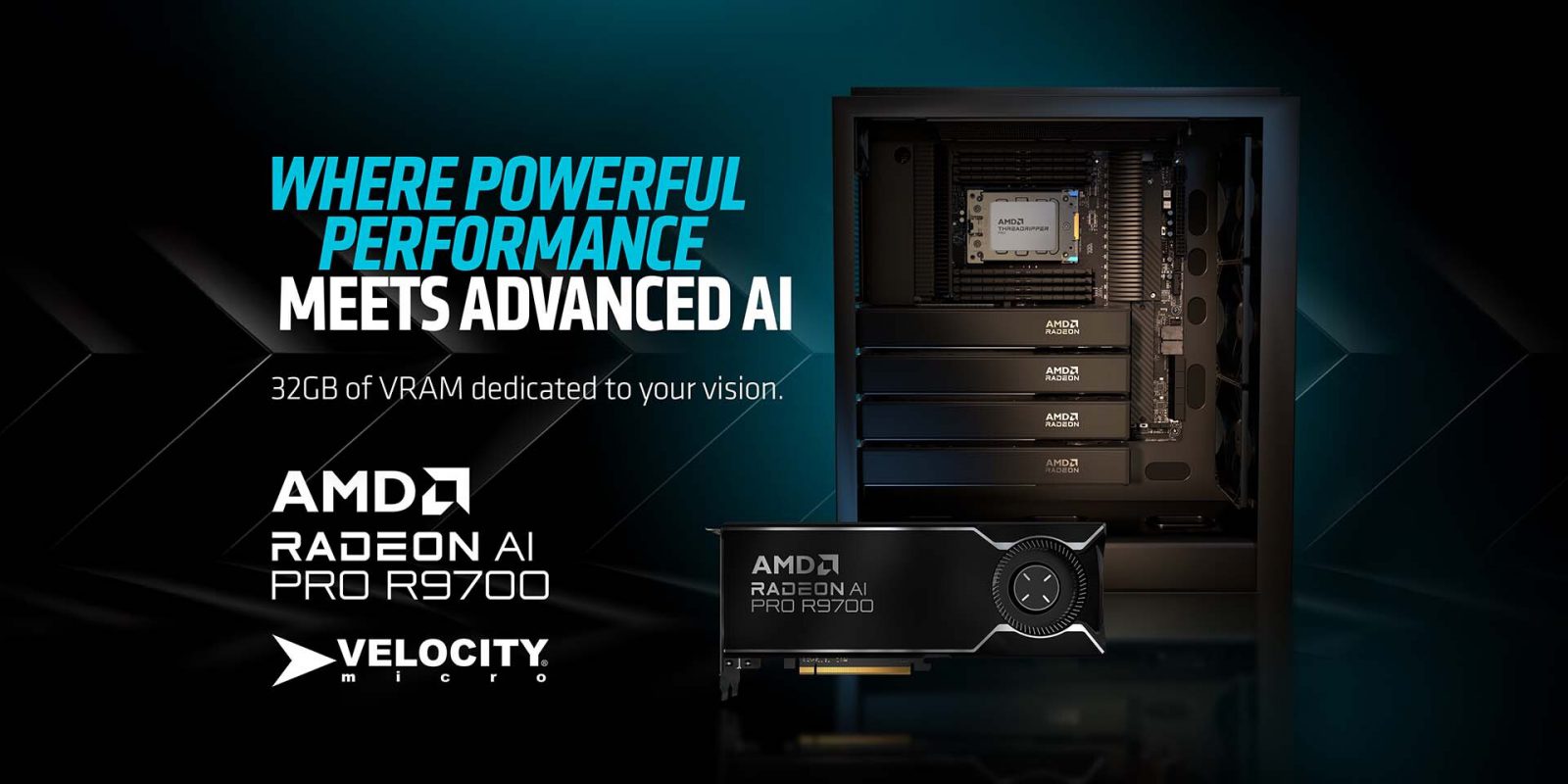
The AMD Radeon AI PRO R9700 emerges as a solution, a professional-grade GPU engineered to handle the requirements of local AI tasks. Equipped with the new AMD RDNA 4 architecture and a substantial 32GB of GDDR6 memory, the R9700 provides the necessary throughput and processing capability for advanced AI development, simulations, and generative processes.
Built for Local AI at Scale
Key specifications for the Radeon AI PRO R9700 include:
- Compute Units: 64
- VRAM: 32GB GDDR6
- Memory Interface: 256-bit
- Memory Bandwidth: 640 GB/s
- AI Accelerators: 128
- FP16 Dense Performance: 191 TFLOPS
- INT4 Sparse Performance: 1531 TOPS
- Power Draw (TDP): 300W
- Interface: PCIe 5.0
The substantial 32GB VRAM capacity is a crucial advantage. This large buffer supports high-performance inference and training for complex models, reducing the need to transfer data to slower system RAM.
Performance Comparison: AMD Radeon AI PRO R9700 vs NVIDIA RTX 5080
Benchmark tests involving models such as Phi 3.5 MoE, DeepSeek R1, and Qwen 3 32B Q6 demonstrated the Radeon AI PRO R9700’s significant lead over NVIDIA’s GeForce RTX 5080 (16GB). When handling extensive prompts and high-parameter models, the Radeon card achieved up to 496% faster throughput in tokens/sec, a vital measure for LLM performance.
Token Throughput Benchmark (Higher is Better)
- Phi 3.5 MoE Q4: RTX 5080 (16GB) 100% (baseline), Radeon AI PRO R9700 (32GB) 361% (+261% uplift)
- Mistral Small 3.1 24B Instruct 2503 Q8: RTX 5080 (16GB) 100% (baseline), Radeon AI PRO R9700 (32GB) 437% (+337% uplift)
- Qwen 3 32B Q6 (Standard Prompt): RTX 5080 (16GB) 100% (baseline), Radeon AI PRO R9700 (32GB) 447% (+347% uplift)
- DeepSeek R1 Distill Qwen 32B Q6: RTX 5080 (16GB) 100% (baseline), Radeon AI PRO R9700 (32GB) 454% (+354% uplift)
- Qwen 3 32B Q6 (Large Prompt >3000 tokens): RTX 5080 (16GB) 100% (baseline), Radeon AI PRO R9700 (32GB) 496% (+396% uplift)
Source: AMD RPW-495 Benchmarks, May 2025
This data indicates that for professionals working with large prompts or full-sized models locally, the Radeon AI PRO R9700 offers a transformative performance advantage.
Ideal Use Cases for Radeon AI PRO R9700
The AI PRO R9700 is suitable for professionals and researchers in fields such as:
- Large Language Model Development: Enables local fine-tuning and testing of LLMs like Qwen, Mistral, and DeepSeek without compromising model size or performance.
- Generative Design & Simulation: Supports CAD simulations and generative AI workflows locally, eliminating the need for cloud-based compute.
- AI-Driven Content Creation: Facilitates the use of advanced text-to-image applications, including Stable Diffusion 3.5 Medium, which typically requires over 20GB of VRAM.
The card also features native support for the AMD ROCm framework, optimizing it for deep learning frameworks like PyTorch and enhancing compatibility across various AI pipelines.
Multi-GPU Scalability & Form Factor Advantage
A significant benefit of the AI PRO R9700 is its capability for multi-GPU workstation configurations. Its compact design and PCIe 5.0 compatibility allow users to enhance performance by integrating multiple cards, which is essential for inference farms or training environments requiring high concurrency.
Conclusion: A Smart Bet for AI-First Professionals
The AMD Radeon AI PRO R9700 represents a significant advancement for local AI. With 32GB of VRAM, 128 AI accelerators, and exceptional token-per-second performance, it is specifically designed for the future of machine learning and large model development on desktop systems.
Professionals looking for a high-throughput, scalable, and efficient alternative to cloud computing or GPUs with limited memory will find the R9700 to be a strong contender. It is available on the ProMagix HD150.
