

Given the broad economic situation and the specific challenges currently facing the games industry, expectations for financial results might lean towards the negative. Microsoft’s Xbox numbers presented a somewhat somber start, raising the question of whether the Xbox division’s difficulties were due to its own strategic issues or indicative of broader industry-wide problems.
With the holiday quarter financials now released for both Sony and Nintendo, the answer is not entirely straightforward. However, a reasonable interpretation suggests that the console market is actually holding up admirably in terms of both hardware and software sales. While some weak points require careful monitoring, the overall figures should offer reassurance regarding the industry’s general health.

Sony’s figures, despite showing a year-on-year decline in the third quarter and year-to-date, are arguably the most encouraging. PS5 sales are slowing, with 8 million units sold in the December quarter compared to 9.5 million a year prior, but overall performance remains strong. The console has shipped 92.2 million units and is largely matching the PS4’s trajectory within a few percentage points – an impressive feat considering the console is notably more expensive at this stage of its lifecycle than its predecessor.
The performance of software and services is even more robust; Sony’s console is experiencing increased software sales and service revenue, with PlayStation Network also continuing to grow its user base reasonably well. Slowing hardware sales are expected for a console in its sixth year on the market; every other metric reported by Sony painted a picture of a healthy business.
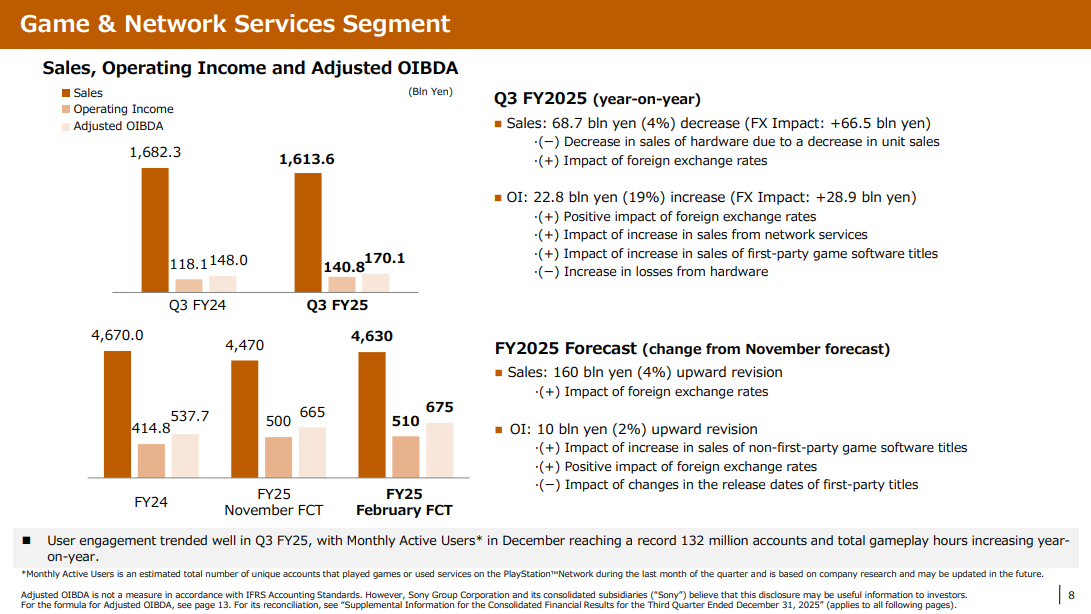
This does not mean that discussions about cost and barriers to entry can cease. A significant factor in the console business remains that the best-performing consoles typically sell within the 100 to 120 million unit range, consistent over the past couple of decades; genuine headline market growth continues to be elusive. Within this market, however, the PS5 is performing as well as any console could, and rising software and services revenue indicate it is on track to be Sony’s most commercially successful console yet.
Nevertheless, having consoles that receive price hikes and become more expensive over their lifecycle represents a significant experiment. Sony’s gamble has not significantly hurt sales thus far, and the company will comfortably achieve an installed base of over 100 million by the end of this year.
That timeframe is particularly notable because it is when GTA6 is now expected to arrive. It is difficult to discuss Sony’s console in 2026 without considering the impact of what is arguably the most eagerly awaited media launch in history. However, GTA6 may not provide a gigantic sales bump to hardware; anticipation for its launch is largely factored into the installed base at this point. Nonetheless, GTA6 will provide the platform for the PS5 to see out its lifecycle in good form, likely helping to keep sales consistent through 2027 and push the PS5 towards the 125 million+ line that Sony will be targeting.
Similar to Sony, Nintendo reported some mixed news in its financials, though the overall reaction to its numbers appears to have been somewhat cautious. Sales of Switch 2 have been weaker outside Japan than the company anticipated, although this appears to have been offset by stronger sales in its home market, meaning overall targets are not being revised.
This situation offers an interesting validation of Nintendo’s decision to provide a price-cut in Japan by effectively region-locking the version of the Switch 2 sold at retail in that market. It will be interesting to observe if a similar long-term boost occurs for the PS5, which followed suit a few months ago with a cheaper Japan-only digital model. It also arguably raises the prospect of further experimentation with region-locking to control costs in price-sensitive markets outside Japan, although Japan is somewhat unique in this regard given the size of its market and the significant devaluation of its currency in recent years.
Like Sony, the reported fluctuations from Nintendo occur within a broader context that is largely positive – the Switch 2 has sold tremendously well despite arguably facing a fairly tough set of market headwinds. Nintendo’s situation is undoubtedly more vulnerable to the macro economy; it relies heavily on a very price-sensitive segment of its market (largely parents purchasing devices for children or family use), whereas PlayStation’s core consumers are more devoted enthusiasts who, while vocal about high prices, will generally still pay them (up to a point).
That said, the high price of the Switch 2 is only one part of the equation. Nintendo also clearly experienced some challenges in the holiday quarter due to an uncharacteristically weak software lineup. The Switch 2 still lacks a major Mario or Zelda title, and while a Mario Kart title is always significant, Mario Kart World faces a unique challenge from Mario Kart 8, which remains one of the best-selling video games in many markets.
A positive aspect from Nintendo’s perspective is that no company is better positioned to address this type of software lineup weakness. The Switch 2 had a solid start and now has considerable potential for improved sales when major titles become available. While a dip in overseas markets at the end of last year is worth noting, significant concerns over the console’s trajectory are not yet justified.
Despite concerns over consumer sentiment and general economic well-being, both Sony and Nintendo enter 2026 with very healthy markets for their platforms. The upcoming year will bring its own challenges – economic headwinds are unfortunately not expected to dissipate soon. On a more positive note, there is the possibility of Sony experiencing the first hints of competition in the living room from a new rival for the first time in many years, with Valve’s Steam Machine reportedly still on track to launch in the first half of this year (though the company is currently expressing concerns about launch timelines and pricing targets).
The fact that these platforms – and Steam – provide a solid, commercially stable base for the industry is very important during such uncertain times. Even Microsoft will find relief in seeing its rivals on firm ground; its best hope to steer the Xbox business back onto a successful trajectory relies on its ability to perform exceptionally as a third-party publisher on platforms like the PS5 while it completes a strategic overhaul of its own platform. For everyone else, it will simply be a welcome relief to see headline figures that tell a largely positive story.
